



On Sunday, October 4, Brazilians will vote for president, members of Congress, state governors and local officials. Three weeks later, it is very likely they will vote again, in a run-off to select either Luiz Inácio “Lula” da Silva or Flávio Bolsonaro as leader. This is Latin America’s largest country, re-producing its state in a moment of global chaos, a regional “shift to the right,” and brazen foreign intervention from the North.
Given the crises in the rest of the world system, too little attention has been paid to these contests; even on the ground in Brazil, the atmosphere is not nearly as politicized as it was in 2022, or 2018. But this is a deeply significant election cycle.
To explain its importance, we turned to a philosopher, a social scientist, a journalist, and an organizer. They are four of the most eloquent voices in the country, and we asked them to explain two things: What matters about Brazil, right now; and, how should the rest of the world understand the events unfolding this month? They came at the questions from four different angles, and we think their responses will be relevant for all of October and beyond.
Rodrigo Nunes is professor of philosophy at PUC-Rio and the author of Neither Vertical Nor Horizontal. His second book comes out in English as Anatomy of Disintegration: What Brazil Reveals About the Global Far Right on October 6 — he wrote about Bolsonarismo. Camila Rocha is scientific director of the Center for Critical Imagination at CEBRAP, and author of Menos Marx, Mais Mises — she wrote about Brazilian democracy. Piero Locatelli is a journalist in São Paulo who has worked for outlets such as Carta Capital and Repórter Brasil — he wrote about Yankee imperialism. Stephanie Weatherbee Brito is Secretariat Coordinator of the International People’s Assembly in Brazil — she wrote about social movements.
Crisis unresolved — Rodrigo Nunes
A lot will be decided in the first round of voting. The right is poised to win major states, and Brazil’s “most right-wing Congress in history” could easily be replaced by one that is even more so. In that case, the presidency would remain the last citadel held by Lula and the Workers’ Party (PT). Even though the incumbent has led most polls, the sheer fact that a figure of his historical stature is at risk of losing to someone as lacking in credentials as Flávio Bolsonaro gives a sense of how bad things are for the left.
That does, of course, speak to some of the shortcomings of Lula’s third term as president, which has lacked the luster of his administrations from 2003 to 2010. Unlike those governments, which lifted some 20 million people out of poverty and dramatically expanded access to higher education, his return to Brasília in 2023 has come with no such major achievement to boast, nor a coherent narrative to offer about itself. Its most important achievement, a reform that did make the tax system fairer for the poorest, is hardly the kind of stuff that stirs passions, and the improvement of economic conditions has failed to register in the lives of the many people still struggling with underemployment, private debt and an online gambling epidemic. (Last month, Lula signed an act that banned betting websites from Brazil, in a popular move that the opposition decried as electorally motivated.)
Clearly, however, the weaknesses of this administration cannot explain the continuing appeal of Bolsonarismo. In my work, I argue that Bolsonarismo is best understood as the convergence of tendencies that were already highly disseminated across different classes in Brazil: a desire for the militarization of social conflict; social conservatism; neoliberal entrepreneurialism; anticommunism; and a somewhat selective concern with corruption, among other factors. Although they had been coming together since the 2015 campaign to impeach Lula’s successor, Dilma Rousseff, it was Jair Bolsonaro’s presidential run in 2018 that first gave these confluent tendencies a political leadership and common identity. As a result, the former president is still the main manager of this political capital, and yet Bolsonarismo may well go on without him.
One way to understand the class alliance that has coalesced around this project is to think of it as the meeting of those who have given up waiting for the promises of modernization to be realized, and those who have stopped pretending that the promises they made were real. On one side, there are those juggling several jobs, working informally or in the gig economy, dealing with the economic downturn of the post-2015 period, strained public services and unaccountable institutions. To these, Bolsonarismo offers, if not clear material advantages, the promise that, if they cannot count on the state, the state will at least get off their backs, leaving them free to manage their own risks as they see fit. Bolsonarismo also offers the unhindered exercise of whatever little power they have, in however small a sphere that may be — even if it is just by telling jokes about minorities.
To Brazilian elites, on the other hand, and particularly those in agribusiness and extractive industries, Bolsonaro offers the same, but writ large: predatory capitalism outside any control. Between these two groups, there is a middle class that is bitter from losing some of its markers of social distinction vis-a-vis the ascendant poor; from this milieu come some of the most ardent Bolsonaristas and many of the political entrepreneurs that have made a career out of far-right agitation.
It remains to be seen how Lula, should he win the likely second round of voting at the end of October, will choose to play out his final term: by avoiding conflict, as he did this time around, and running the risk of seeing a complete triumph of the far right in 2030; or by hazarding what needs to be done in order to not only stop it from advancing further, but make it retreat.
Danger and Dust — Camila Rocha
Brazil is still one of the largest democracies in the world. But that may change if Flávio Bolsonaro is elected this month. To understand what is at stake, we must understand what the Bolsonaro family represents.
Flávio is the eldest of Jair Bolsonaro’s four sons. A former Army captain, Jair was an unimportant extreme-right congressman for decades, until he was elected in 2018 amidst a crisis of confidence in Brazil’s political system. During his presidency, Brazil lost tens of thousands of lives to Covid-19 as a direct result of Bolsonaro’s government, and the Amazon lost tens of millions of trees.
After he lost the 2022 election to Lula, Bolsonaristas in the armed forces attempted to assassinate Lula, his vice-president Geraldo Alckmin, and Supreme Court justice Alexandre de Moraes. The president and his allies attempted to organize a coup d’etat. They supported the crowds that attacked the seat of Brazilian democracy on January 8, 2026, with the goal of creating the conditions for a military intervention.
Jair Bolsonaro was imprisoned along with the golpista officers in 2025 and is currently under house arrest. Even though his conviction has reduced his political appeal, more than a third of Brazilians think that there was no coup attempt, and his supporters believe he is the victim of political persecution.
Flávio Bolsonaro, senator for Rio de Janeiro, promises to imitate Javier Milei’s economic policies and Nayib Bukele’s security forces. He would submit completely to Donald Trump and seek to free his father from prison.
But concrete proposals are not central to his campaign, and many of Flávio’s supporters feel represented by the broad defense of his father’s legacy, a concern for “family values,” and the deployment of populist law and order discourse. In office, Jair Bolsonaro did not actually make the country safer, but Bolsonaristas believe Flávio will try; if he wins, he may push to classify Brazilian gangs as international terrorist organizations and expand the prison population.
Recent coverage has focused on his involvement with the failed Banco Master, which perpetrated one of the largest frauds in Brazilian history. This corruption scandal has unique institutional impact: at least five members of the Supreme Court, out of eleven, are connected in some way. The Court could be weakened, if not decimated, by the development of the case.
Flávio’s connection to the case – the financing of a film about Jair Bolsonaro – has not hurt his standing in the polls. It appears the race could go either way. This will be a battle of who is less unpopular – around 47% of the electorate disapprove of Lula, and 47% disapprove of Flávio.
But what frightens undecided voters the most is Flávio’s historic connection to Brazilian organized crime groups, made up of cops and former police officers, known as milícias. The “militias” control essential services in favelas and poor parts of Rio, working as a parallel state that extorts the citizenry and threatens residents with death. According to Brazil’s most important conservative newspaper, Bolsonaro’s victory could bring milicianos to the top of the Republic. For a long time, I hasten to add.
Given the crisis at the Supreme Court, Flávio could appoint a majority of its members, free his father, and keep his family in power for years. Lula will be not be able to run again after 2026, and his party is facing decline – there are few leaders at present who seem capable of taking on a President Flávio backed by the Supreme Court.
Even though Donald Trump may be losing support in the United States, the election of Flávio would mean, in practice, Trump’s total domination of South America; it would also reduce Brazil’s sovereignty to dust. At the same time, Brazilians would be represented in a new constellation of extreme-right global leaders. The reactionary international would not just gain another member, they would get a whole family.
Late-stage hegemony — Piero Locatelli
Since 1989, when democracy returned to Brazil, the idea that electoral politics were subject to foreign influence has been mocked and cast to the margins of “public debate.”1 The concept was treated as some fossil left over from the Cold War, the kind of thing that old Leninists and the paranoid mumbled about. To employ imperialism as a category of analysis was to abandon serious interpretation and leap into the world of conspiracy.
All of that changed this year. The concept of foreign interference has become mainstream. Even the pretenders to center-left respectability – our own versions of Ezra Klein – and academics normally obsessed with efficient institutions speak openly of the support offered by the United States of America to Flávio Bolsonaro. Commentators who ignored (real) U.S. influence in other recent episodes in Brazilian history2 see very clearly, this time, what is happening.
Obviously, the reversal did not take place because they all picked up a copy of “Imperialism: the Highest Stage of Capitalism.” So what happened?
In part, Donald Trump makes it much more difficult to ignore these dynamics. His lack of subtlety makes the machinations impossible to miss: Brazilian businessmen admit on podcasts that they are part of U.S. networks that work with Brazilian campaigns; firms linked to Donald Trump, Jr. invest in the extraction of rare earth minerals here; and Republican officials do paid advertising spots promoting Flávio’s chances on Polymarket.
And then there are Trump’s actual policies. Brazil has been the target of a series of measures, such as the imposition of tariffs, Magnitsky Law sanctions, and the revocation of visas held by Supreme Court Justices. All of this had the open support of Eduardo Bolsonaro, Flávio’s younger brother, who now lives in Texas.
But there is more than a shift in perception underway. Beyond the Trumpian theater, there are exogenous and endogenous factors that explain a rise in foreign interference.
The internationalization of the Bolsonarista campaign can be seen as a response to the fragility of its domestic alliances. Unlike his father Jair, Flávio has not received the full support of national agribusiness, financial capital, and the country’s floating political blocs. Without that coalition, an alliance with Trump has become more important than ever, and Flávio has turned to Benjamin Netanyahu and Javier Milei for more support.
And then up North, there are reasons for the United States to be more interested in Brazil. First, a series of victories by Trump allies in the hemisphere – the most recent being Abelardo de la Espriella in Colombia – has transformed Brazil into a large, left-leaning island on a right-leaning continent. These developments have taken on a more concrete form with the launch of the Shield of the Americas, which seeks to combat organized crime, in theory, and functions to corner Lula in practice.
The decline of US power in general, and rise of China as a competing power, have also led to a more chaotic and unpredictable Monroe Doctrine, around which many competing interests are at play – from the worlds of airplanes to soya and valuable minerals. The PRC is now Brazil’s main trading partner.
The country has re-awakened, so to speak, to the reality of U.S. intervention. But there is no domestic reaction that corresponds to the gravity of the threat. The contrast with 2022, when Brazilians ousted Bolsonaro, is all too clear. Back then, the idea that democracy was at risk led to unusually broad alliance in Brazilian society. This year, people are discussing “national sovereignty,” without raising the tools to defend it.
Mobilization and organization — Stephanie Weatherbee Brito
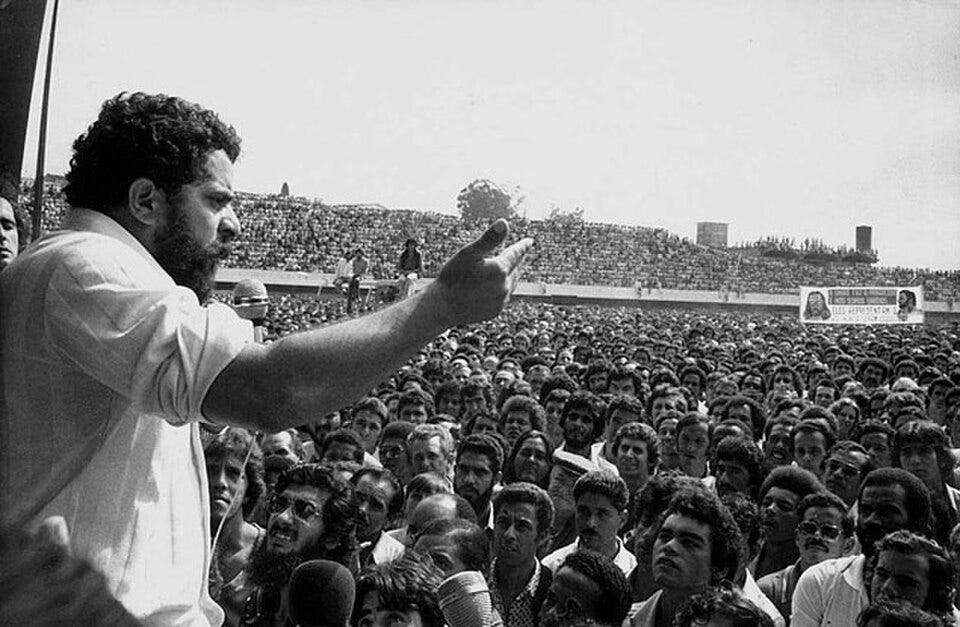
For decades, the Partido dos Trabalhadores (PT) has relied on the mobilization of mass movements to win elections. In this hemisphere, there is perhaps no political party with deeper roots in organized working-class power. However, both the party’s historic allies and younger progressive movements have become demoralized by the right’s ascendancy, with many on the left disappointed by Lula’s third term.
Essentially no one in these groups questions that Lula is the only choice for the country this year. But at one recent meeting, a veteran organizer complained that it was harder than ever to mobilize volunteers for elections. “No one campaigns anymore, unless they are paid to do so.”
Brazil’s popular movements today fall into two broad camps. The first is the bloc of well-structured organizations that emerged alongside the PT in the 1980s, comprising unions like the Central Única dos Trabalhadores (CUT) and social movements such as the Movimento dos Trabalhadores Rurais Sem Terra (MST), which pushes for radical land reform. Members of this bloc still turn out for rallies, but their capacity to mobilize the wider public is weaker than it was last century.
Then, there is a more diffuse network of single-issue progressive groups: the Black, women’s, LGBTQ and indigenous movements, and – since 2023 – the opposition to the genocide of Palestinians. Very broadly, these groups are more likely to support the Partido Socialismo e Liberdade (PSOL) than to have a close affiliation with the PT. Unlike the first camp, they openly criticize the Workers’ Party and the conciliatory and moderate line taken by the government since 2023.
The PT has argued that this defensive position was required to save democracy from fascism, and it is true that we are in an existential battle with the far right. But I have seen in my work with grassroots organizations, left parties, and anti-imperialist groups that several elements in this administration have dampened vital mass enthusiasm: austerity in the economy, moderation of development policy, and timidity in foreign policy. Unlike the Lula of the 1980s, 1990s and 2002, who ran for office as a man seeking to transform Brazil, this Lula is running as the candidate who will defend the country’s institutions.
Until 2013, the Brazilian left never had to contend with a right that could mobilize in the streets. But that year, protests for affordable transportation turned against the PT and the left in general. Today, extreme right rallies have shown themselves capable of drawing large crowds, while the left is still demoralized by the shock more than a decade later. Each Bolsonarista mobilization is met with horror, and another bout of reckoning with its own loss of organizational capacity.
This does not mean the left stopped mobilizing. In 2024, a range of progressive forces and mass movements forged a new cycle of protests, plenaries and organizing around a demand that put the left back on the offensive: killing the “6x1” law that allowed employers to limit workers to one day off per week. Yet the PT and its government were slow to embrace a popular cause that expressed class consciousness and deepened politicization.
The stakes of the moment are bigger than the current presidential race. Without organized popular power, the PT’s electoral machine will face a right with both street and congressional power. A narrow victory, looking incredibly plausible at the moment, will leave Lula stuck in the corner: hamstrung by Congress, confronted by a bellicose right, and without the backing of a committed mass base.
This is especially true of the limited spaces for the circulation and legitimization of ideas, which comprise large media outlets, key sectors of the academy, and non-governmental organizations, and which all came together after Brazilian re-democratization.