


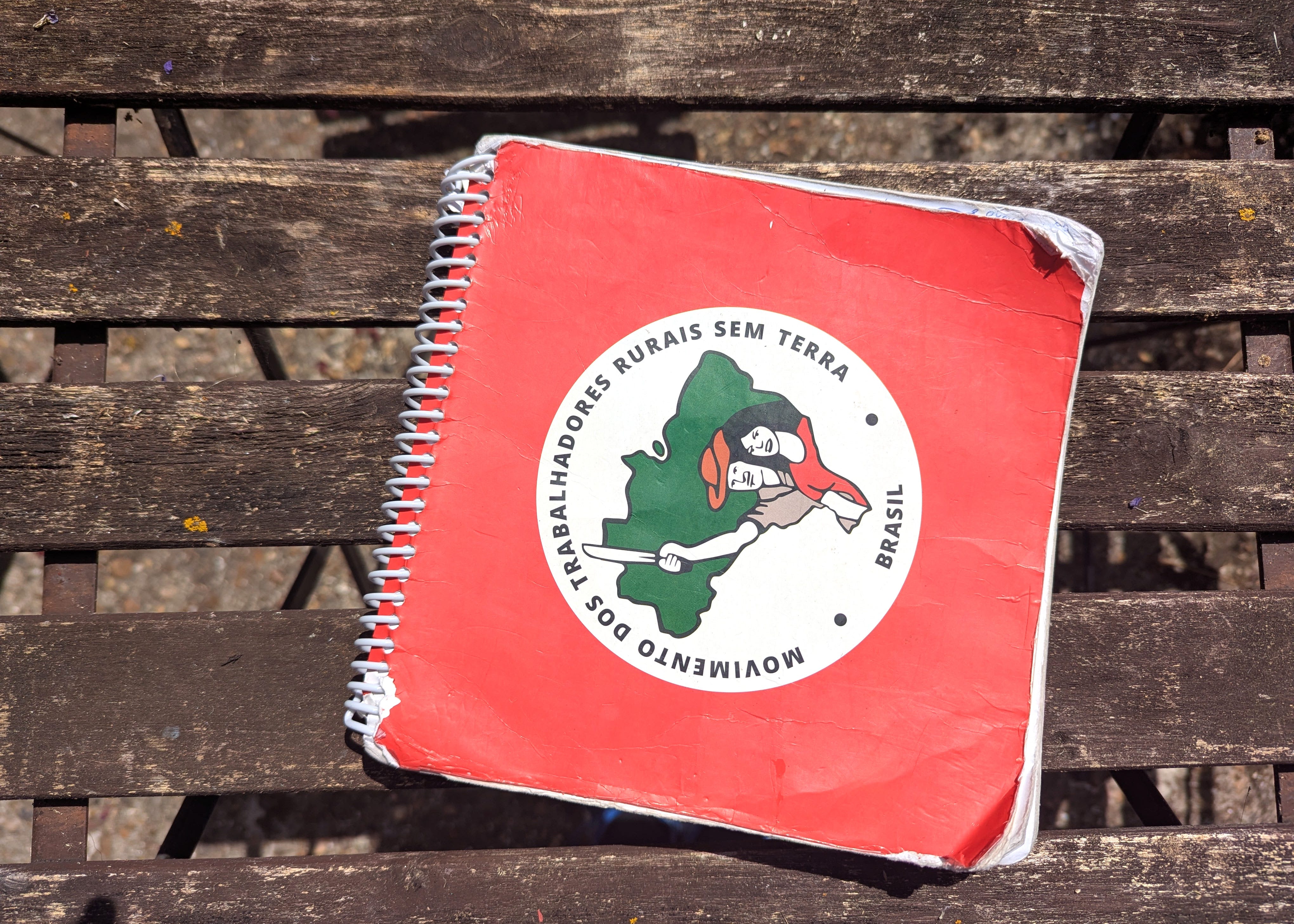
Brazil’s Landless Workers’ Movement (MST) is now one of the world’s largest and best-known social movements. The hundreds of thousands of families in the Movimento dos Trabalhadores Rurais Sem Terra push for radical land reform, most famously by occupying unused or misused land and agitating for redistribution.
Founded in 1984, the movement became especially famous — and a symbol of determined resistance to the far right — under the disastrous government of Jair Bolsonaro, when it mobilized its militants to oppose the president and deployed its material resources to feed starving Brazilians. What is less well-known is that the MST runs its own publishing house, Expressão Popular, which is an important part of the country’s intellectual ecosystem. Since 2012, Miguel Yoshida has served as its editorial coordinator, publishing with a focus on class struggle, anti-imperialism, and the future of the Global South. Miguel spoke to North South Notes in June and July.
Vincent Bevins: A lot of people have heard about Brazil’s Landless Workers’ Movement — it has become somewhat famous worldwide in recent years — but I don’t think many know that the MST has its own publishing house. How did this come to be?
Miguel Yoshida: The publishing house was born in 1999. Why then? Well first of all, 1996 was a difficult and decisive year for the MST. That was the year of the El Dorado de Carajás Massacre, when 21 landless workers were killed by military police. In response the MST organized a long march to Brasília, which managed to constitute a significant social mobilization against the neoliberal policies of President Fernando Henrique Cardoso.
At the same time, the MST — and other social movements — came to the conclusion that there was a need to make a theoretical leap, as well. In what sense? After the fall of the Berlin Wall there was, not just here in Brazil but around the world, a wave of disillusionment with the left. You know: “Ok, socialism didn’t work, let’s give up.” We knew of many intellectuals that simply threw their libraries in the trash, right? “Fine, Marx, Engels and Lenin no longer explain our world.” That was the sound of the stampede at the time.
So the generation in our struggle in '96, '97, '98, was disconnected in a way from the generation that had fought against the dictatorship — the generation that had received a more classical Marxist education.
VB: So, the decision was to return to the classics, in a new context?
MY: Right. The conclusion was that we needed to recuperate the classic theory of political organization to advance in struggle. The thinking was: “Great, the organization of [land] occupations and marches is necessary, but we need to push further in order to wage political struggle in a broader sense.”
The first book published by Expressão Popular, in 1999, is called “Lenin and the Russian Revolution.” The second book is an anthology of the writings of Rosa Luxemburg. And then, a book written by Michael Löwy about Che Guevara. You can see those titles as foundational to our philosophy — and our overall goal has always been the formation of militants in Brazil’s popular movements.
VB: Since then, how many books have been published?
MY: Nine hundred. About 60% are works by Brazilian authors, and 40% are translations of foreign titles. And we always work to publish books as cheaply as possible, so that the average worker can read them.
VB: Yes, this is something I noticed years ago. You publish works on agroecology in Brazil, Marx and literary theory, translations of Mao and books on Gramsci, and one encounters these works organically, out on the land occupied or settled by the MST. I remember coming across Expressão Popular books on imperialism and revolutionary history in tents and makeshift homes across the rural interior of a right-wing state like Paraná. Teenage boys or single mothers working the land will have them by their bedside.
In the United States, meanwhile, you often hear the attack that the left is a thing for rich people. That Marx and Lenin are stuff that kids get into at expensive universities.
MY: [Laughing] Yes, we have that insult here too.
VB: But of course it only works if you ignore the entire history of the global left. It only works if you are only ever looking around at rich people in the first place. But more concretely, how do you keep the books cheap?
MY: Well first, a very important part of what we do today is to publish thinkers from around the Global South. Books by African authors are some of our best-selling volumes, as a matter of fact. An anthology of the writings of Thomas Sankara has been in great demand — and we put out work by Amílcar Cabral, from Guinea-Bissau and Cabo Verde, as well as Kwame Nkrumah, from Ghana. We published a Ho Chi Minh anthology, in order to rethink the entire context of Vietnam. That is, how is it that they were able to defeat French and US imperialism? What was it about the combination of Marxist thought and the realities of Vietnamese local conditions that made that possible? It is really important to think about. And then recently, we wanted to stop and reflect on the fifty years since the independence of Angola and Mozambique, of course.
But historically we have had a few strategies for keeping our books cheap. First, we do operate legally as a business with sales revenues and operational independence from the MST, but profits are re-invested into more publications. Secondly, we try to rely on the solidarity of authors, who might grant us publishing rights for cheap or free. And then we have employed an alternative distribution system, which was based on the organization of the social movements themselves. So, one person would be responsible for selling books here or there, you know? At universities, union meetings, and so on, because distribution is really expensive, especially in a country the size of Brazil. As a result of all that, we could often sell books for about half the price of our competitors.
But the pandemic made that last strategy difficult to sustain, and more recently we have been trying to make as many of our books available as free PDFs as possible, on our website.
VB: Oh wow — most publishers try to avoid that kind of thing. Last year, what was your best-selling edition?
MY: A book by Ruy Mauro Marini, the Brazilian intellectual, on dependency theory, a collection called “Dependency and revolution in Latin America.” Then, as I said, the interest in works from countries in the global periphery has been really strong.
The political line on thought from the Global South has been to maintain the classical tradition and to also incorporate these new elements into it. In that way we avoid just being trapped in debates centered on Europe and the Global North — which of course, have their own relevance — and allow ourselves to think about our own circumstances and be in dialogue with those countries.
VB: I wanted to ask about the focus on anti-imperialism at Expressão Popular. The line is very clear in a way which is much less common in the Global North and especially the United States, where one can easily be labeled too anti-imperialist. I don’t think you have published any theorists affirming that the age of imperialism is over, or that every state is equally in need of abolition, and so on. Do you publish any anarchists or autonomists?
MY: No.
VB: I guess the closest thing would be Rosa Luxemburg, right?
MY: Yeah but that’s not very close at all, is it?
VB: You publish extensively on Cuba, the Armazém do Campo1 has a lot of Venezuela materials, and it seems that the line is that left movements do not need to wait for the perfect society or the flawless revolution to learn from experiences elsewhere or offer solidarity. Is that right?
MY: Correct, our view is that it makes no sense to wait for the perfect revolution before offering support or to spread word of real-world experiences.
What do we have as an editorial line? We think the following: we are in a class struggle and we have a principal enemy in that class struggle. Principal enemies, that is. In national terms, it continues to be the bourgeoisie here in Brazil, which is linked to agribusiness, which is linked to financial markets, and which has its international engagements. And that, if we think past our borders, the principal enemy of humanity is imperialism itself – the imperialism of the United States. This is only becoming more clear as a result of Trump’s recent actions.
So here on our side of that struggle, our line is to value the experiences of popular struggles elsewhere, and to value the construction of international solidarity, and to seek to end the vast inequality between nations. That is, to learn from history and the struggles of the people. I think that, deep down, when we think about an anti-imperialist line, it has a lot to do with identifying that principal enemy and understanding history. The experiences of popular struggles have been contradictory, but there are advances within them and possibilities that can strengthen us as well.
Of course, we are not going to align ourselves in a total and uncritical way with existing processes. But at the same time, we will act in solidarity with popular struggles, won’t we? Our view is that there are real-life consequences for people right now. Just look at Cuba and the situation the country is living through — an economic blockade that is worse than ever. At the same time, how is it that the Cuban experience is fundamental for the global left to understand? Since 1959 there have been contradictions, weaknesses, problems, and yet, Cuba remains a large — shall we say — breath of fresh air. A ray of hope. That’s our line: look squarely at our enemy, and study how we can be stronger to defeat it.
VB: Has the nature of US imperialism changed significantly in recent years? Has the publisher sought to reflect on the impact of the current Trump administration, for example?
MY: As far as publications go, we put out a book by a Cuban journalist on Marcio Rubio thought. It’s an analysis of Rubio himself — called “Marco Rubio, pathological liar” — it demonstrates how this son of immigrants bases his entire career on deeply xenophobic prejudice, with the explicit intention of recovering imperial power over Latin America.
And our evaluation is that what is clearly at stake is the hegemony of the United States — the empire is in decline — and this empire, feeling threatened by rising powers such as China and other nations in and outside the BRICS, becomes more and more aggressive and destructive. When a beast is cornered, it lashes out in desperation, and imperialism in its current phase appears to be firing at everyone in every direction. That critical reading sustains our curation of anti-imperialist work.
VB: This year, Lula will run for his fourth term in office. The MST has a long and complex relationship with him, of course. Will this be a focus of publications, events, discussions, and so on?
MY: This will be a really important year for Brazil and for Latin America. There is the possibility of continuing with a progressive government in Lula — or, there is the possibility of an extreme-right victory, as we have seen across the region recently.
What we have planned is a series of books on the policies and politics at play. So, in August we will launch a study of the relationship between agribusiness and the extreme right. As we see it, our political role is to denounce those kinds of problems, to raise those kinds of issues. And we will have a series of events based on the books that have, in some way or another over the years, centered the advances made by the working class under progressive governments and explore the difficulties of that process; we will also feature books that demonstrate the real threats posed to the population by the far right.
VB: And what about this rightward shift in Latin America? Is this a serious threat?
MY: Personally, I think — and this is also the belief throughout our editorial committee — there has been a real turn to the right in Latin America, and this is something we study carefully, just as we study the foreign policy of Donald Trump and its relation to the phenomenon.
For a long time, we have explored both progressive advances and the threat of imperialism at the level of Latin America, rather than just within individual nations. And we believe we are living through a moment that puts imperialist offensive back at the center of the agenda. Starting in the early 2000s the region experienced a wave of progressive governments, and now we are living through the return of an era of combat — the extreme-right governments in Latin America, in our view, constitute an international imperialist network led by the United States.
VB: Finally, I want to ask you about another way of interacting with the community, something that I have noticed seems to be important to the publisher. What is the importance of maintaining physical spaces for dialogue, of putting on events and keeping alive a vibrant left-literary culture in the real world? What explains your focus on this kind of interaction in a world in which people sit at home alone on their phones?
MY: This is fundamental and something we have thought long and hard about. So, the numbers indicate we are probably the second-most important left publisher in Brazil now, behind Boitempo, and we have a great relationship with them. Along with them and other members of the International Union of Left Publishers (IULP), we put on “Red Books Day.”
The essence of neoliberalism resides in the excessive cultivation of atomized individualism. The idea behind our spaces — the bookstore, the café, the Armazém do Campo and the Elza Soares Cultural Center — is precisely to subvert this logic.
We want to rebuild community ties and the culture of presence in socializing, with things like launches, debates, and reading clubs. To offer a refuge of conviviality disconnected from the commercial logic and world of compulsory work that surrounds us. The strength of the working class emanates from its capacity for collective articulation, and we cannot cede this territory.
VB: Miguel, thanks so much for your time and for the depth of your reflections.
MY: Of course. We’re always available to advance in debate. Ciao ciao.
This interview has been translated from Portuguese and condensed for clarity.
Expressão Popular shares a building with the São Paulo Armazém do Campo, or “Country Store,” which sells both organic MST food products and apparel, such as t-shirts or their famous red hat.