

“To the extent that non-bourgeois strata penetrated the public sphere in the political realm and took possession of its institutions, participated in press, parties, and parliament, the weapons of publicity forged by the bourgeoisie were pointed against itself…. [For liberal theorists,] the public itself had taken the place of princely power, and the accusation of intolerance was now leveled against the public opinion that had become prevalent.” — Jürgen Habermas, The Structural Transformation of the Public Sphere, describing changes between the 17th and 19th centuries.
“Each child in NYC basically costs an extra $100k per year minimum...brutal...” — user taobanker on X, the everything app, describing a screenshot of a lady reporting in 2025 that she cannot survive on 850,000 dollars a year.
In the first years after the invention of the printing press and the formation of a reading and writing community in Europe, the “public sphere” was open-ended and horizontally structured. If you could read books and newspapers, if you could compose a letter, you could participate. Within this new sphere, participants were treated as equals. Reason would prevail, regardless of your status in the old feudal order. “The parity on whose basis alone the authority of the better argument could assert itself against that of social hierarchy and in the end can carry the day meant, in the thought of the day, the parity of ‘common humanity,’” wrote Jürgen Habermas in 1962.
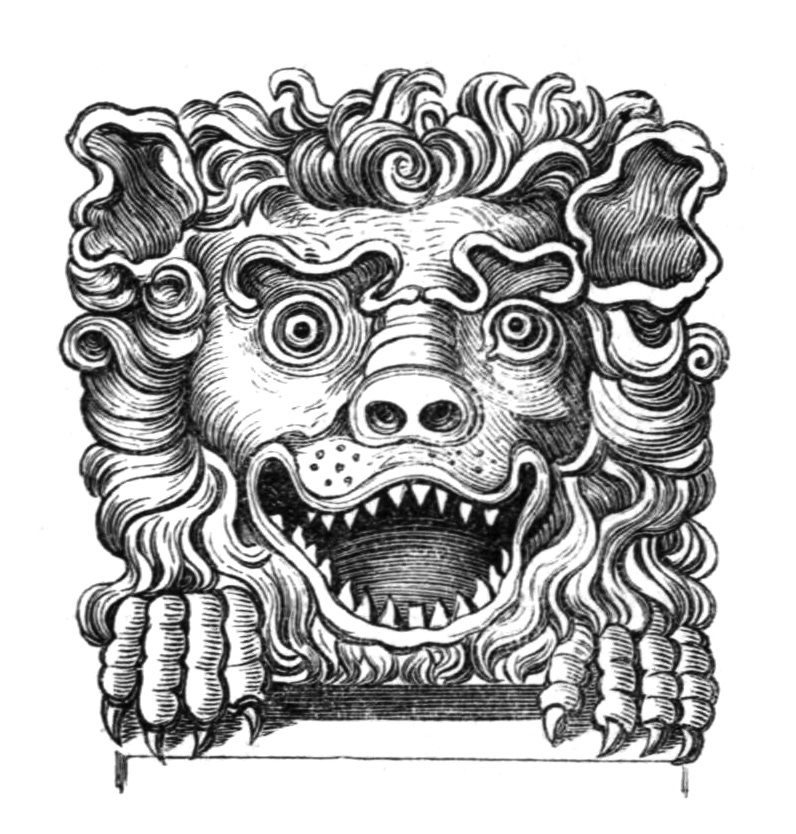
The emphasis is mine. This was the self-conception of the participants in the early public sphere. The Marxist response, which no one really disputes anymore, is that this was actually a very limited and particular class of people with quite a lot of shared interests. It was very easy for them to believe that the public sphere was universal, and for them to relate to each other as equals, because there were all kinds of (invisible) barriers to entry. A tiny minority of people could read, and afford to buy newspapers or books, and walk into Button’s Coffee House in central London and stuff a letter into the fantastical lion’s head that served as a receptacle for letters to the editor. You might be allowed to win an argument against a Duke, if you were both invited to a literary salon. But there were no workers there. There were no Irish people, no peasants, and certainly no Indians. Thus Habermas explains, quite uncontroversially, that in its early days “the public” was actually the bourgeois reading public.
When more and more people began to read, write, organize, criticize, and otherwise enter the “public sphere,” this proved to be a real problem for the European bourgeoisie. A lot of these new entrants wanted to take their property away. Instead of constituting a bulwark against the power of the Crown, “the public” was now the real threat, as far as they were concerned.1
As a class, the bourgeoisie moved to impose hierarchy upon a sphere that had initially been egalitarian. You couldn’t let just anyone control the press. They worked together to impose visible barriers to entry on a previously open community once the old invisible barriers fell away. This happened in concrete history, not in abstract theory, and took a number of interesting forms — stamp duties, state monopolies, outright prohibition of the radical press, complex licensing systems, “philanthropy” with ideological conditions attached, endless lawsuits, and so on.2 But I don’t want to get into all that. Obviously, what I am trying to say here is that over the last twenty-five years, our ruling class has done something very similar to the internet.
There are numerous examples, but the first one I want to highlight is the way that Twitter has changed since Elon Musk purchased it. About a decade ago, I would have said that English-language discourse on the website was dominated by left-leaning downwardly mobile millennials, Bernie supporters and Gawker writers and rudely funny alumni of older message boards. I think Musk felt that way too, and convinced himself that these people were being unfairly mean to him and destroying Western civilization — to his mind, these were basically the same things. And that is why he bought the company.
If you log onto X right now, you can see that he has somehow succeeded. The timeline is dominated by business psychos and crypto scammers and serial founders and people who either make thousands of dollars a week in “passive income” or pretend to do so in order to trick people that believe they can. The character that dominates the “global public square” (Elon’s words) is now, unquestionably, a rich guy. They did not need to criminalize radical speech (though some other people are certainly doing that); it was enough to give wealthy people the pre-eminent status that they enjoy in the offline world.
It’s not like Hegelian grad students or Vice bloggers were exactly the global proletariat; despite some of our pretensions a decade ago, this very specific class, with our own particular interests, was much better off than the average human being. The platforms were not dominated by Filipino taxi drivers or Nigerian pensioners (if a couple of them were funny enough and posted all day, they might rise to the top). But that cohort has been replaced by a really special group. The tweet above this post is an extra-stupid example, but it is trivially easy to find people who consider “<$100k” to be the lowest income bracket imaginable, with $250k required to feel that “life is good.” In the United States of America, the richest country in the history of mankind, the average individual income is $39,000 / year. In the People’s Republic of China, the workers assembling the iPhone make about three dollars an hour, and that is not a poor country. The people who ripped the materials out of the earth make much less.
Or take Meta, the company run by millennial ad salesman Mark Zuckerberg. On his platforms, we used to look directly at our peers. Now, we look up to our superiors. Instagram is obviously structured as a kind of pyramid, with a rich person in Los Angeles — probably Kylie Jenner these days, having replaced her older half-sister Kim Kardashian — sitting at the top. It used to be that “social media” meant you looked at what your friends were posting, and you posted for your friends. Now, you can still post an Instagram story, but you will be competing with celebrities and the professional producers of short-form content. Instead of participants in a conversation, everyone is now a broadcaster, and some broadcasters are obviously more important than others. A few regular people might win at this game, and move up the ranks — but the fact that I use the word “up” there is the point. Once more, hierarchy has been imposed; concrete horizontality has given way to vertical structure.
Once upon a time, anyone could go online and argue in a chat room, post on message boards, or make a website. This was the era of libertarian techno-optimism, the days before elite counter-attack. After all, who was on the internet in the very early days? At first, it was just members of the US military, trading messages;3 then, a small network of academics; then, a smattering of well-off families in the United States. Few powerful people understood what was going on, but what did they have to worry about? In the early 2010s when “social media” began to take off, those new spaces were dominated by the young, highly-educated and well-connected. This cohort tended to be urban and progressive. This was the era of left-leaning techno-optimism, still anchored in some of the anarcho-liberal assumptions that permeated the early internet. These were the years of Obama and Tahrir Square and Occupy Wall Street and then, Euromaidan, which led to a horrible war which has not ended, which is killing people as I type.
Should we be surprised that the era of 1999 to 2013 was the high point of “horizontalist” ideology and praxis in the world of politics?4 This was the moment in which the new digital world was still open and egalitarian, horizontally structured. As I wrote in my second book, I came to the conclusion that “elective affinity” between a few pre-existing ideological currents and material developments in the 2010s helps to explain a recent era of mass protests. Obviously, there were not that many fully committed horizontalists as the era began (and they were still a minority in the demonstrations themselves), but quite a lot of people believed in the potential of the form of resistance that has been possible in our age, or all those people would not have participated. If enough of us get out onto the streets, we will surely push the world in a progressive direction — wait, where did all these reactionaries come from?
I don’t want to overstate my case here. We are talking about three distinct phenomena; the rise of commercial media and mass culture is different than the rise of the digital platforms, and, as we have seen, the “2011” form of protest remains with us, even as ideas and the internet have changed. The most important material basis for the apparently spontaneous, leaderless mass protest is a society which is atomized, precarious, and individualized, and I don’t expect unplanned street demonstrations to become “vertical” (how would that work?) just because digital life now has a different shape. You could, if you like, wonder airily if the new structure of the internet (rigidly ordered, with some people obviously more valuable than others) helps explain why so many kids these days find fascism such a natural fit, while every anglophone radical in 2000 claimed to either be an anarchist or libertarian, but this might be stretching the interpretive frame. We are working at the level of analogy here, not strict correlation.5 I confess I am still working out how exactly I conceive of these relationships. But I think there is something there.
The arrival of the printing press re-shaped society, and then real power relations in society imposed themselves on the world of letters. The internet was born in a world with pre-existing elites and the internet created new elites; initially, its shape was flat, and then both types of elites used their strength to seize it and re-shape it in a way that reflect power relations in society.
In the case of Facebook and Instagram, it was not the ideology of the owner that led to the imposition of its current structure. These services, like TikTok and YouTube, were transformed by the logic of the maximization of advertising revenue, just like so many media were in the 20th century. The "algorithms” (computer programs) restructured the experience of online life in such a way that you are now just supposed to watch little TV clips, whether they are actually paid advertisements or just resemble them in form, tone, and preoccupation. A decade ago, a “keyboard warrior” was someone who spent too much time speaking back to the internet in the form of text; the term was pejorative, but it was true that social media programs were soliciting that kind of engagement. Now you aren’t supposed to use your keyboard at all.6 That is valuable time you could be using to view an advertisement.
In the last fifteen years, we have also seen the state getting involved in more direct ways. We had a couple years before political and economic elites knew how to deal with the internet, but they are long gone. The Trump administration is making sure that TikTok USA can be controlled by Larry Ellison, the ardent supporter of Israel and MAGA. That same family acquired The Free Press, a Substack with a decent audience, and paid much, much more than it would be worth if Bari Weiss did not further the ideological project of the Ellisons. They’re going to be reading your social media if you ever want to come to the United States ever again. Might as well stop posting — just keep scrolling and watching.
The obvious exception to this now is “AI,” the conversation you can have with a large language model. In this window, most everyone is invited to bang away all day on the keyboard. For now, that is. My bet is that if any of these firms come up with a working business model, it will mean restricting access and treating different users very differently. But even in this early moment, you are all by yourself, and you are talking to a computer program, so this will never be part of the public sphere.
“The right to free expression of opinion was no longer called on to protect the public’s rational-critical debate against the reach of the police but to protect the noncomformists from the grip of the public itself.” All quotes are from Habermas 1962, edition published by MIT Press (Boston: 1989), pages 126-133.
See Anthony Smith, The Newspaper: An International History (London: Thames and Hudson, 1972), especially pages 23-95.
Yasha Levine, Surveillance Valley: The Secret Military History of the Internet (New York: PublicAffairs, 2018).
In my second book, If We Burn, “horizontalism” receives a lot of attention — perhaps a little too much for those not so concerned with the central Brazilian case. But for those who have never heard of it, it is enough to think of it as an approach to politics and activism in which everybody must always be at the same level: absolutely no leadership or hierarchy whatsoever.
The key insight of Jo Freeman’s landmark text, “The Tyranny of Structurelessness,” is that concrete horizontality can easily give way to the imposition of a version of structure and authority that is more hierarchical and oppressive than you would have chosen, had you believed in choosing and creating intentional structure yourself. A band with five members might be able to make all decisions as equals; the same goes for a committed group of 15 activists; but once you scale up to large numbers, some kind of an organization and shape is going to appear; the question is which shape and who chose it. So, the loose analogy here is that in the world of print, the internet, and in the mass protest, initial horizontality gave way to a shocking form of imposed hierarchy. The years in which “netizens” believed in the power of networked democracy, 1990 to 2015 or so, were also the years that a new class of oligarchs arose and quietly seized control of the state.
In 1962, Habermas already worried that the culture industry had generated a “post-literary” stage. Things are a bit worse now. I confess I chuckled a bit when I remembered he had back then diagnosed that the era of mass commercial media, radio and television was “taking on feudal features.” And for Kant, enlightenment does not consist of simply participating in a community of educated readers — it cannot. It means “thinking for oneself,” which means speaking in public in a meaningful way. There is no public sphere without user participation.
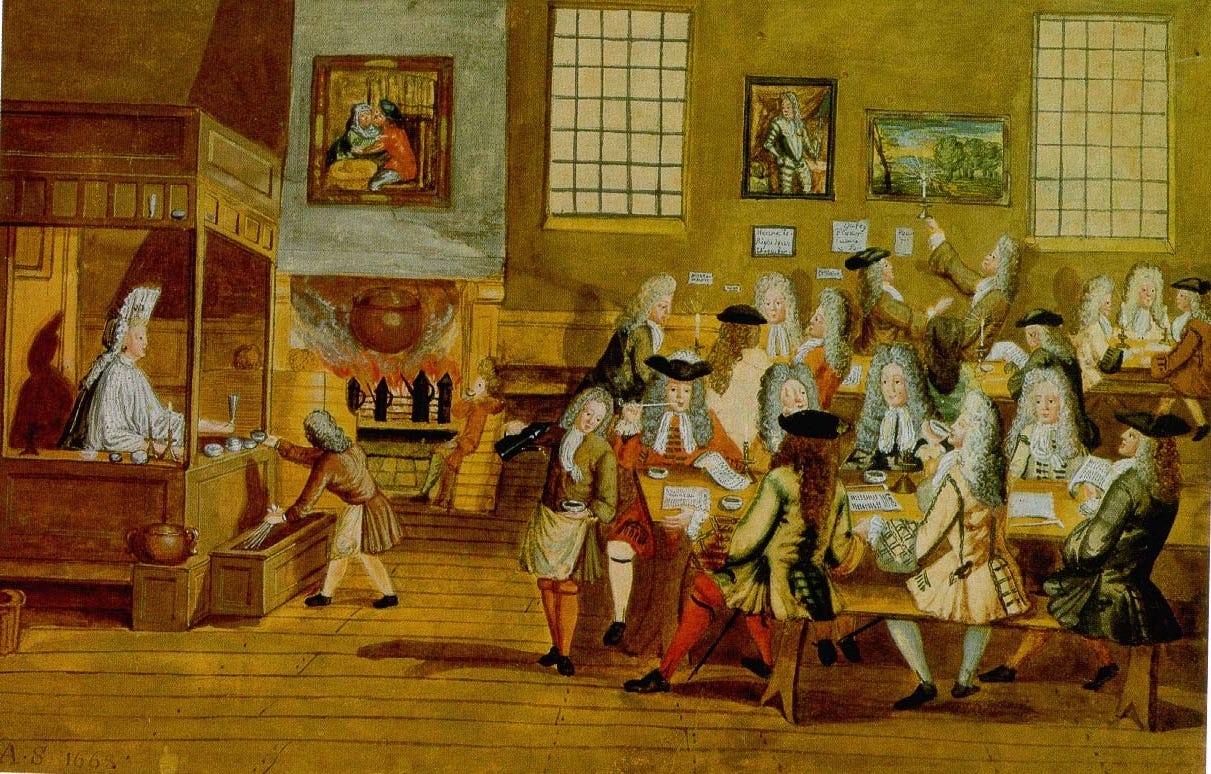
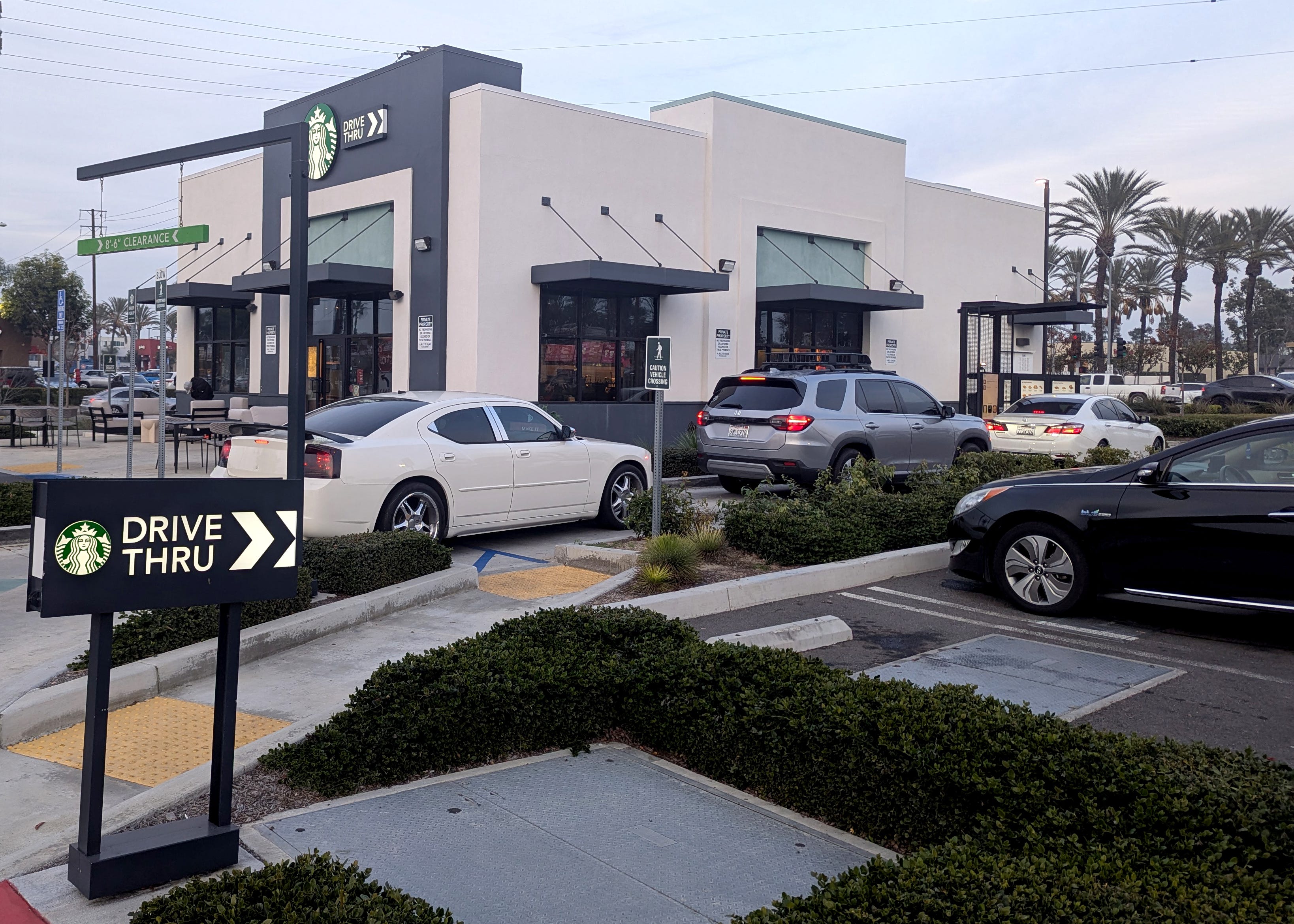
Pictured above, in order: the lion at Button’s coffee house; Interior of a London Coffee-house, 17th century; the 21st century coffee house, photo by Vincent Bevins, December 2025.
I watched the matrix again recently and it reminded me of just how horizontal the internet and ideas about the online space were in the 1990s and early aughts. Would highly recommend a re-watch if you haven't seen it in a while!
Back then, in our bedrooms, we could create different identities for ourselves (largely based on curiosity / persona experimentation, rather than trolling), hang out in 'lounges' in simulated worlds. it was a space for weirdos, coders and maybe I'm viewing it with rose tinted glasses but those early days invoke what Derrida talked about when he wrote about deconstruction - being possible to read intertextual slippage in home-made urls and the re-use of data present on home-made websites. The horizontal-ness allowed for boundless opportunities for interpretations because we were creating our own 'homes' and 'visiting' others online.
Now, we have been streamlined into accessing the internet via platforms and even our search engines exist as a hierarchy. There's absolutely something there when you talk about youngsters today finding a home in fascism - maybe because it's information presented to them rather than what they've actively searched for.
Students I teach now have to create 'mind maps' before writing essays to articulate how they have reached the idea and point they're making. I'm interested in the evolution of Digital Gardens for internet users. For now, what is revolutionising my internet use is bogglingly simple - the Bookmarks tab.
It reminds me of the newspapers in Mexico in the late 1990s, which, along with radio and television, maintained right-wing and pro-government positions. There were few places in the media where official positions were questioned. Some newspapers and news programmes seemed ridiculous to me because they had so much advertising. This situation seems like a repeat of that, but on steroids.