

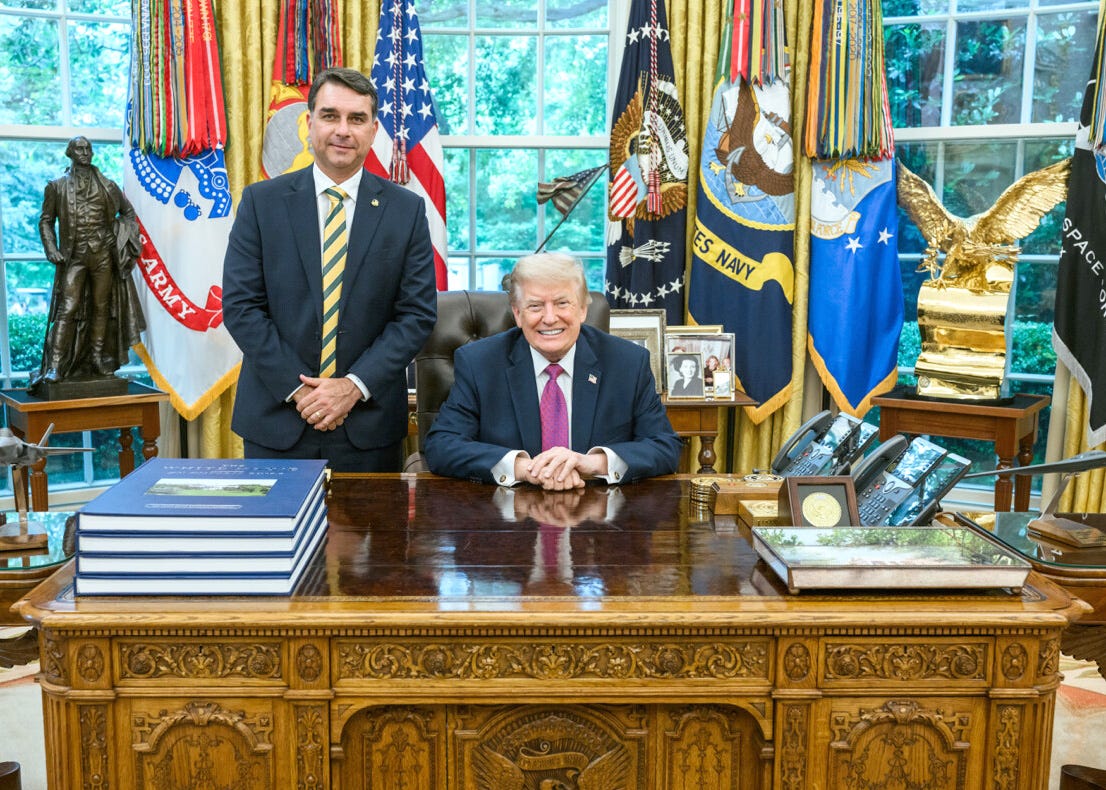
"The fact that a billionaire real estate playboy who liked to slap his name on steaks and wine has proven to be a better diplomat and military strategist than every other politician and foreign policy expert over the last 30 years is such a damning indictment of the DC establishment I honestly don’t know how they recover.” — William Wolfe, 2026, on the day the United States and Israel attacked Iran.
“Power and violence are opposites; where the one rules absolutely, the other is absent. Violence appears where power is in jeopardy, but left to its own course it ends in power’s disappearance.” — Hannah Arendt, 1970
“International law is fake and gay.” — Matt Walsh, 2026
There is a story I like to tell, from Brazil, that I believe reveals something about contemporary right-wing populism. In 2018, soon after Jair Bolsonaro’s surprise presidential victory, the extreme-right former army captain announced that he would abolish the Ministry of the Environment. You see, his presidential campaign had made the assertion — and I think that he really believed this — that the Amazon rainforest held untold, untapped resources made inaccessible by powerful, politically correct, communist environmentalists and scientists. If you just got rid of the bothersome bureaucrats, you could waltz into the jungle and return with a big pot of gold. But what happened, very quickly, is that Brazilian agribusiness leaders told him that they quite liked the setup they had. They were already exploiting the Amazon. Destroying the Ministério do Meio-Ambiente, they said, would actually be very bad for the national bourgeoisie. Simply torching the mediating structures between capitalists, the state, and global markets would hurt them more than it would help. So everyone stuck to torching trees, and the Ministry remained.
There were many ways Bolsonaro could wage war on the forest and indigenous people, and grant privileges to his supporters on the lawless frontier; that is another, deadly story. But none of those wanton attacks translated into major boosts for national GDP. To actually make money from things like beef and soybeans requires participation in complex international systems. There was no big red button labeled EXTRACTION, guarded by a couple of woke treehuggers, that you could just push to generate billions.
As we now know, Bolsonaro was quite bad for the Brazilian economy. Most famously, he lost the support of many elites by mismanaging the country during the pandemic. If he had been good for growth, I think he probably would have succeeded at the abolition of democracy which had been his political project for decades; one of his coup attempts likely would have been a success.
In 1970, Hannah Arendt published On Violence. We can set aside the context of the essay and my quibbles to focus on a powerful single point. The threat of violence might lurk behind power. But, she writes, the appearance of violence is evidence of the absence of power. Power is incomplete, or being contested, when violence is visible. Conversely, unlimited violence annihilates power.
An extreme example might suffice. If a prison warden has total control over his prisoners, they will be sitting calmly in their cells, as he wants, or making license plates. A fight between prisoners, or a riot, or an attempt at escape, is obviously something he has no interest in seeing. He will employ violence, of course, in these moments, to restore order and establish the threat that more will be employed in the future. But total power would never have required it. And if he kills every single prisoner in retribution, there is no one left to make license plates.
As the United States continued to kill millions of people in Vietnam, year after year, this was obviously evidence of a lack of U.S. power in Southeast Asia. The bombs kept dropping because the Vietnamese refused to lose; what Washington would have preferred is that in 1956 or so the whole country become reliably anticommunist and allied with the United States. What happened instead is that Vietnam won the war.
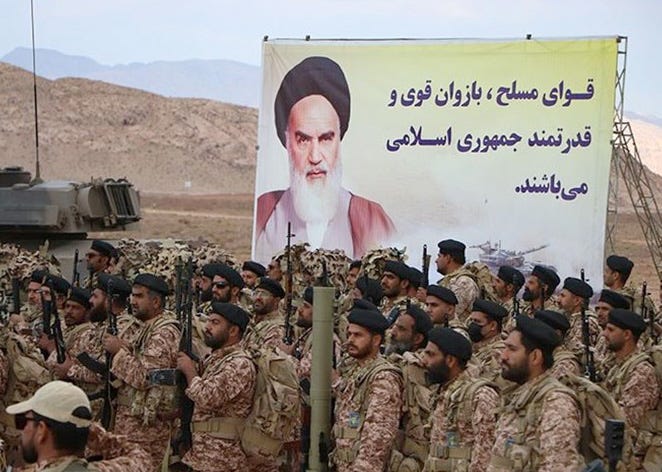
In October 2025, I wrote here that we should see “regime collapse” as a hidden or second-order goal for a lot of United States operations. Whether or not they dream or pretend to dream of a democratic, flourishing Libya or Lebanon or Cuba, successive administrations have shown themselves to be very happy to accept the simple and total destruction of “enemy” societies.
After the surprise January attack on Venezuela and arrest of Nicolás Maduro, Jeremy Shapiro coined the term “regime alteration” to describe what Trump actually pulled off. They got rid of the guy at the top and now have a more pliant partner in power, at least according to the story that MAGA tells itself.
But what is hard to remember now, just a few months later, is that Donald Trump’s government was emboldened by the apparent success in Caracas. They didn’t just turn their sights on Iran. They began to starve Cuba. Remember when the United States threatened to invade NATO and conquer Greenland? That was earlier this year. At Davos, they launched the cronyist “Board of Peace” in an attempt to sideline the United Nations.
At the end of January, I tried to coin the term autogolpe imperial or “imperial self-coup” for this top-down offensive—to describe the interrelated attacks launched by the hegemon on the very system it shaped. (I can keep citing myself, this is just a blog.) The analogy is to a “self-coup” at the national level, in which the sitting executive smashes the mediating structure of his own state to seize more power.1 Trump and MAGA, at the beginning of 2026, were acting in this manner at the international level. They clearly believed they could wring more power and treasure out of the world system by running around and killing people and threatening everyone.
Then the United States and Israel attacked Iran. The entire operation, but especially the behavior of Pete Hegseth, revealed a bizarre misunderstanding of global affairs. The United States Secretary of War started shouting that we were going to commit atrocities and crimes against humanity, and that is why we were going to win. This alarmed even the most ardent supporters of U.S. empire. The parallels with Bolsonaro are obvious. These guys thought there was a giant red button marked VIOLENCE being guarded by a couple of queer studies professors, and all you have to do is smash it to subjugate countries at will. As if no one had tried that before.2 As if the Islamic Republic had never contemplated an attack from Washington.
In a mob movie, Pete Hegseth would be the young hothead who runs around town roughing up small-business owners and killing people who don’t even get in his way. The wise old mafia boss has to pull him aside and say, “What the hell are you doing? We already had a good thing going here. This is hurting business. We need to be feared, but also respected.” At some point, the hothead probably gets himself killed.
The point of this blog is to issue an update: Obviously, Donald Trump failed. The attempted world-systemic self-coup of the first half of 2026 did not work. Iran stopped it. It is too early to say if the war is really over, or if Iran “won” exactly, but it is obvious that Donald Trump did not succeed. He will not get regime change, regime collapse, or any kind of alteration favorable for Washington. But he did not just fail in Iran – can anyone argue that the United States is more powerful in Europe, or Asia, than it was on January 1st? Even in Latin America, the best MAGA can offer is a question mark.
That makes two failed coup attempts for Trump. Let’s set aside the question of whether January 6 was a coup attempt — you don’t get to become the new government just because you occupy the buildings, of course, just ask the Nepalis. But Trump clearly tried to stay in power after losing the 2020 election. In characteristic fashion, he did not really know or care how to do it effectively; he just sort of lazily asked the military, Congress, and the courts to do it for him (in Latin America, where there are more words for these things, that would be golpe militar, golpe parlamentar, and golpe judicial, respectively). A Guatemalan told me, back then, that she would call Trump a failed autogolpista. For all we know, Trump may be remembered primarily for these two failed (self-) coup attempts, five years apart: 2021 and 2026.
What is amazing is that people really thought this would work. Matt Walsh, conservative commentator, wrote: “The only international law is that big and powerful countries get to do what they want.” OK, right, who wrote those international laws? The biggest and most powerful countries after World War II, the United States most prominent among them. This setup has served Walsh’s country pretty well. The United States finished the century as the most powerful country in the history of humanity. The current system was profoundly shaped by U.S. power, and Washington often broke the rules when needed. In my view, international law is more than just a crude expression of realpolitik; it limits and it also generates. But these guys seem to think that the rules only serve to constrain the United States. Therefore, the thinking goes, if you just go out there and do the exact opposite of what international law says, you get to be king of the planet.
Finally, it is sadly true that the failure of a coup attempt does not mean that it has no consequences. Iranians are dead. Cuba is still under siege. The world has been shaken. If Bolsonaro had not intentionally starved his own government of resources in the Amazon, I believe my friend Dom Phillips would still be alive today.
In the comments in January, some people reasonably asked for concrete examples of the “autogolpe,” in history. One classic example is the one carried out by Alberto Fujimori, whose daughter hopes to take over as the president of Peru in July.
Fittingly, Lily Lynch called this the “you can just do things” form of governance.
I dread thinking about what this flailing, failing Empire will do to the rest of us on its way down.
And thanks for this important reminder:
“Power and violence are opposites; where the one rules absolutely, the other is absent. Violence appears where power is in jeopardy, but left to its own course it ends in power’s disappearance.” — Hannah Arendt, 1970