

I still remember the horror on our colleague’s face, right after George W. Bush’s 2004 re-election, when we scoffed that the choice between Democrats and Republicans was a choice between two versions of the same platform.
We were two immigrant sociologists in the Midwest of the United States: I, a Turkish scholar, and a peer from one of the smaller post-Soviet republics. To us, the Democrats represented just another face of U.S. capitalism.
Our U.S.-born colleague, a prominent figure in our field, was shocked by our callousness. We were trained as ethnographers (albeit of other world geographies) and should have known to be more attuned to the local scene and its complicated dynamics. Instead, we were behaving like crude foreign anthropologists, stepping on cultural landmines; two “Occidentalists,” if you will.
Today, I inhabit a world in which it is assumed that everyone knows what a Democrat is, and the Democratic Party’s platform is treated as a universal version of liberal democracy. But what is this party, really? An outsider’s perspective (if not quite an Occidentalist one) might help reveal its dynamics. How would I explain this party to someone back in Turkey, or to someone in Ghana or Brazil? How does it relate to the Republican Party, and more importantly, to the world?
Even though the Democratic Party has about 46 million registered voters, it is quite rare to encounter people who are actual, card-carrying, active Democrats. Many people identify with the party, and a good number of them are quite fired up, yet it is almost impossible to spot local party branches in U.S. towns and urban centers. For someone like me, who grew up in Turkey where even smaller parties have visible headquarters in almost every town and urban district, this is disorienting.
That is not to say that the party is not real. The Democrats stand for certain values and interests in a divided nation. None of the issues they champion (gun control, climate adaptation, sexual and reproductive rights) can be trivialized or minimized. Today the party appears to represent progressive professionals, liberal capitalists, working- to middle-class minorities, a dwindling section of the organized working class, and left-wing (but non-revolutionary) social movements.
An outsider’s history helps to see the party more clearly. The Democrats emerged from a particular place in the global system; it only became possible to mistake their values for universal after the United States gained hegemonic status, and the party became the stewards of empire.
1. The party of small farmers
At its outset in the 1820s, the Democratic Party was a coalition dominantly comprising slave-holding planters and white, mostly small farmers, who were bound together by their opposition to industrial and financial elites and their support for the ethnic cleansing of indigenous populations.
Over the next three decades, white male suffrage expanded, flooding an unprepared system with the votes of small producers who felt increasingly threatened by deepening capitalism. Their unease frequently turned radical, but there was no meaningful industrial socialism in the U.S. at this point. Even wage workers thought of themselves as independent producers, and unlike in Europe, opposing “wage slavery” did not mean calling for the expropriation of capitalists and the establishment of collectivist enterprises. Instead, the idea was that everyone (that is, every white man), not just artisans and farmers, should own their own small workplace.
Towards the end of the 19th century, American capitalism became increasingly industrial, and the bourgeois wing of the party grew stronger. But there were countercurrents. The crises and price shocks of the 1870s and 1880s fomented farmers’ credit alliances and workers’ strikes, which began to unite white and black workers behind the vague promise of empowerment contained in the lightning-rod idea of “the people.”1 In 1892, these movements produced the sturdiest third-party challenge in American history: the People’s Party, which proposed a strong labor twist to the anti-elite, anti-city sentiments already prevalent among Democrats.
By imitating the People’s Party’s discourse, adopting watered-down versions of some of its demands, and swallowing some of its leadership, the Democrats folded this upstart and radical politics back into their own establishment, pro-business ranks.2 They also stoked racial tensions within the populist movement, dividing black and white laborers, and unmooring the People’s Party. It shifted to the center, under the Democratic umbrella. A rump version of the party survived for only another decade. It ceased to exist in 1909.
The panic the populist insurgency had provoked among both Republican and Democratic elites had far more durable consequences. The Republican campaign of 1896 would mark the first time big money dominated the U.S. electoral scene — through party-coordinated mobilization of corporate funds — setting a precedent that would poison U.S. democracy forever. After the Republican victory, both Democrats and Republicans restricted voting in areas under their control, leading to the “system of 1896” — which, in the words of Piven and Cloward, was a “counter-revolution.”3 Poll taxes, residency requirements, and literacy tests blocked migrant and poorer workers from voting for about seven decades.
These workers had constituted the most radical constituents of popular movements in the 19th century. When voting barriers were lifted in the 1960s, they were not quick to return to the polls, let alone to radical movements. And Democrats were not interested in courting them.
Meanwhile, the backlash of 1896 had brought both parties more firmly under elite control — Republicans under Northern industrialists and Democrats under Southern planters. Small farmers, now devoid of their working-class allies, lost their authentic voice and aligned with the agendas of one or the other more powerful groups.
The elitist safeguards against third parties, and against cash-deprived, formally uneducated, migrant laborers introduced by the system of 1896, crippled American democracy for a very long time.4
2. Lib-lab coalition
As the United States matured into the leading power of world capitalism, its imperial aggression — evident since its beginnings — grew. Already by the 1940s, U.S. imperial ambition had surpassed the now-fading British empire both in geographical scope and in the vehemence of its self-presentation as civilized and liberal. Along the way, the Democrats became not only a primary voice of anti-communism but, in lockstep with the Republicans, the organizers of the war machine.
It was essential to the rise of the anti-communist empire that the two Democrats who arguably defined the American century, Woodrow Wilson and Franklin Delano Roosevelt, each appropriated unfolding global revolutions.5
In the late 1910s, Wilson moved to steal the fire of national liberation abroad, which was increasingly being articulated as a socialist and communist principle.6 The United States administered an “anti-colonial empire,” promising and in fact supporting national liberation where it undermined its rival the Soviet Union, while vigorously suppressing it within its own sphere of influence.7
Less than two decades later, FDR’s New Deal appropriated a wave of left-leaning workers’ dynamism at home. The Red Scare, a wave of anti-left repression beginning late in World War I, had initially stymied the rise of socialism in the United States. But the Great Depression of 1929 brought on labor’s most radical decade. Not just formal workers, but also semi-employed and unemployed people occupied streets, set up cooperatives, and engaged in mass and general strikes. They did not restrict themselves to wage and benefit demands. Many of these movements and actions called for control over production, belying later stereotypes of labor as only interested in redistribution but not autonomy.8
In response, the Democrats went against the industrial elites in their own ranks to forge the New Deal. Under its terms, the bosses accepted high wages and stable employment for a large chunk of the workforce, and in return, the workers ceded control.9 They would no longer seek autonomy, but restrict themselves to sector-limited, wage-seeking labor disputes and refrain from cross-sector solidarity. They abandoned the pursuit of a better society for all oppressed strata in the process. Mike Davis would describe the outcome of FDR’s absorption of the communist, anarchist and socialist mobilization of the 1930s as “the barren marriage” of labor and the Democratic Party.10
Blue-collar participation in the military-industrial complex was another, equally important product of the workers’ settlement.11 Many jobs were now forever tied to foreign wars: the working class had become the committed manufacturer of the U.S. war machine.
The terms of the deal did not remain stable. As organized workers became more powerful, they started to be perceived as greedy and selfish by both the bosses and unorganized segments of the working class. While gaining security and mainstream respectability, organized labor lost not only its autonomy but also its appeal to poorer and more oppressed populations.
The liberal politicians, professionals and bureaucrats whose activism in support of labor and their own career advancement had built the New Deal as much as workers’ class struggle had, would eventually reap a larger share of the symbolic benefits. Militant labor struggles had raised living standards for a large proportion of the population, winning, as the bumper stickers popular in union households still proudly proclaim, even “the weekend.” But it was the liberals and the policy-making machines they controlled, not workers or their struggle, that came to define the Democratic Party and the country.
3. 1968: the deceptive peak of revolution
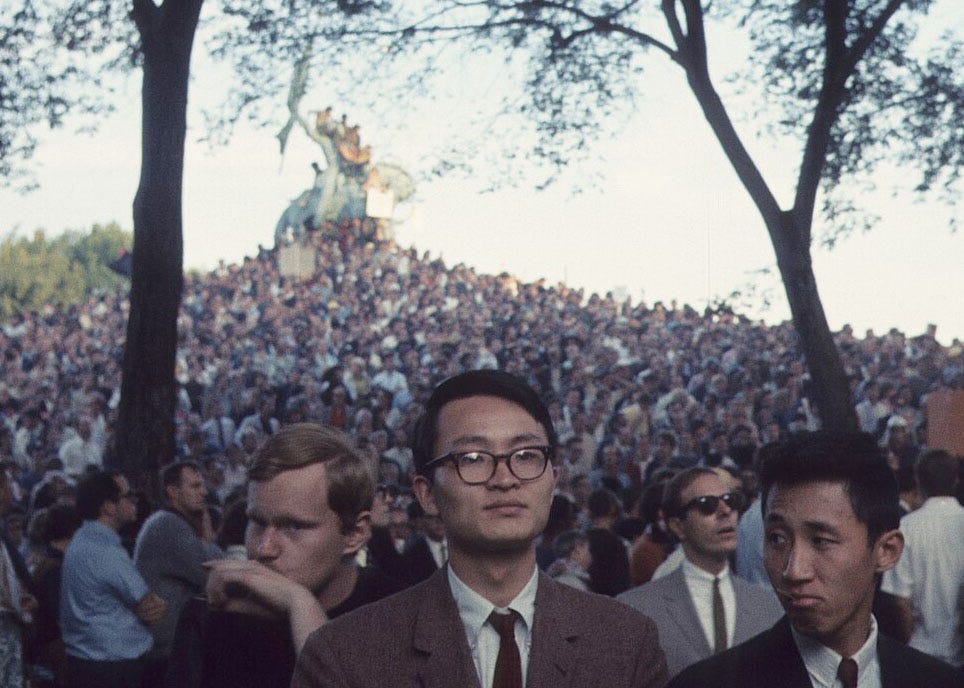
The New Deal coalition was untenable. In the 1960s, anti-imperialist struggles abroad and minority movements at home fractured the Democrats’ hegemonic bloc. This hadn’t been an electoral hegemony: from the 1930s to the 1970s, Democrats dominated the seats of power but did not always win at the polls. Instead, the New Deal had framed the debates and conflicts animating U.S. politics; for five decades, Republicans — the party of the industrialists — had been hostage to its terms.12
The Civil Rights Movement introduced the first challenge. The Democrats could manage the immediate results — the movement’s dynamism initially even allowed the party to win a greater share of minority votes across the nation, especially in urban centers — but its aftershocks proved beyond their control. Southern whites jumped ship first. Workers didn’t desert the party altogether, but they did become increasingly apathetic.
Anti-war and feminist movements further alienated them. The people who attempted to build bridges between labor and these new movements were either on the fringes of the Democratic coalition or in outright opposition to it. The party center made no attempt to forge a link.
Even as the party’s connections with workers weakened, organized labor began to shrink as a force. Internationalization of trade and production was gradually undermining its power but did not automatically translate into labor disorganization. The two parties actively constructed this decline.13 Neither the top echelons of union bureaucracies nor the Democrats initially paid much attention to redefining the labor movement to meet the challenges of globalization. In some instances, they were downright hostile to experiments to open up organized labor to more women and minorities — pragmatically the right thing to do, given their swelling ranks among wage laborers — out of fear of radicalization. As labor’s power in politics and in the party dwindled, the Democrats came to be defined more by their professional, bureaucratic, liberal wing.
The new social movements could have been articulated as class and labor issues, but the established liberal stance resulted in their framing as “cosmopolitan,” educated issues. The institutionalization of this impoverished response to the revolts of the 1960s-1970s, which was sealed with the rise of the Clintons in the 1990s, was the beginning of the end of liberal democracy in the U.S.
4. The distinguished progressives
Eventually, the Democratic Party came to represent the educated, alienating the “uneducated” — people without college degrees. Workers started to desert, either avoiding the ballot box or voting Republican.
But even today, the Democrats are the party with stronger links to organized labor, especially to its top representatives. Non-white workers also remain predominantly aligned with (but not organically represented by) the Democrats, albeit not in their capacity as “workers.” Up until the return of socialism to mainstream American public debates and engagement in the mid-2010s, the progressive wings of the party made radical issues of sexual, racial, and environmental concerns. But they did so without any anchoring in labor and political economy, and without any vision of constituting a new majority and a novel hegemony (i.e. a new version of the New Deal bloc). This further reinforced the image of the party as a coalition of professionals and minorities.
The mainstream of the Democratic Party is in a total state of panic; it insists that progressive challenges (from both socialists and radicalized liberals) are spoilers, yet has no alternative vision to reconstitute the party. The 2026 midterms showed that progressive challenges in fact strengthen the Democratic vote, but it is not yet clear how the establishment will respond to this historic election. White workers and traditional middle classes increasingly perceive themselves as squeezed in between minorities and a rapacious elite, which allows the Trumpist Right to present itself as the party of “middle America,” in both the geographical and socioeconomic sense.14
Yet, unlike interwar European fascists, Trumpists have no social or developmental projects that can truly cement a reactionary coalition of bosses, middle classes, and workers.15 Trumpism — a quite shallow and impoverished version of the far right in comparison to both historical precedents and contemporary fascistic forces in Israel, Turkey, and India — has gained ground not on its strengths, but primarily due to the sad situation of the Democrats.16 The U.S. far right’s gains are fragile, and more easily reversed than those of its interwar and contemporary non-Euro-American counterparts.
The post-1968 internal structure of the Democratic Party is the other component of what I call its “sad situation.” Rather than a member-based organization in the manner of traditional political parties in much of the world, the Democrats are a loose coterie of elected officials, donors, publicists, and would-be candidates. Parties in the United States have always been less member-based than European parties, but during the New Deal era, they were more solidly anchored in communities, with Democrats clearly embedded in working-class milieux. The party’s loss of interest in labor and labor’s own disorganization, as much as its disappointments regarding the party, are core factors in this change. But so is the devolution of U.S. civic life overall.17
Almost all mass organizations have lost membership over the last decades. Some of this is by design: their operatives have “discovered” that fund-raising, lobbying, mailing (and then emailing, and ultimately social media) are apparently more effective ways of getting things done. Both reflecting and leading these trends, the Democrats have deactivated their local chapters.18 The people working in and for the party are now “advocates” rather than mass organizers and regular members.19 Fundraisers like Nancy Pelosi define the spirit of the party. Democrats still aggressively court and lure community organizers into their ranks. But the latter lose touch with their communities as they become a part of the machine. Barack Obama’s trajectory is only a dramatic case of this quite widespread story.
5. Politics at the end of empire
As radical, bottom-up political tendencies were caught and snuffed out over the course of the 19th and 20th centuries, the party’s agency in the world developed in a clearly imperialist direction. Born as the party that led the ethnic cleansing of indigenous populations, the Democrats missed multiple chances in their history to redeem themselves, and instead organized and glorified war at every critical juncture. In the last reckoning, the Democrats are the party of empire quite as much as the Republicans are — hence our shoulder-shrugging reaction to those election results back in 2004.
From the perspective of a Libyan or Iraqi whose family was massacred during U.S. invasions, Hillary is not necessarily better than Donald, and might appear even much worse. In my native Turkey, I had difficulty until only several months ago in explaining why Republicans are objectively speaking much worse for the world: many people bought into Trump’s self-presentation as the president who would end the forever wars. I argued against this shameless propaganda, but my more knowledgeable interlocutors repeatedly reminded me of the Democrats’ eager participation in the making of neoconservatism and the subsequent destruction of the Middle East.
It’s true that Trumpism has led the U.S. empire in a still much more destructive direction, but the path right up to the current turn was paved by Democrats and Republicans usually acting in unison. For a century and a half, the two parties have mostly shelved their significant, and occasionally substantial, differences when it comes to foreign policy. Despite exceptions to this general pattern — and the possibility that Trumpism might upend it — what characterizes the U.S. “anti-colonial empire” is still the promotion of life and liberty in the backyards of other empires (as in the “color revolutions” of our century) and their ruthless suppression whenever they come into conflict with narrowly-defined “American interests” elsewhere in the world.20 It doesn’t matter which party is in power.
But given the challenge from the Democratic Socialists of America, the Democrats have a chance of moving in a different direction. If they don’t, the party could face chaos and a nasty split. That could leave the U.S. in the hands of reactionaries, which would be disastrous not only for the nation but for all the countries that would be wrecked by its nuclear and conventional arsenal.
Yet, it could also lead to the ultimate liberation of labor and other U.S. social movements — for so long shackled to the Democrats and their war machine — and pave the way for emancipation worldwide. This could, for example, take the form of a third, independent mass party representing blue-collar workers, minorities and downwardly mobile professionals against the dominant system and its forever wars.
My post-Soviet colleague could no longer stand the indifference to world dynamics and the pettiness of political infighting in the U.S. A native of a country long colonized by neighboring empires, he was marked by the Soviet breakup, which, despite his deep sympathy for the liberation movements he had studied critically, he had to admit had resulted in debacle. Rather than witness another imperial collapse from within, he left.
I stayed in the U.S. and “went native,” as anthropologists would disparagingly say, even though I’ve kept one foot outside. I am cautiously optimistic given the dynamism of the young generations. It could be a fool’s wager, but their increasingly systematic attempts to redefine the left might be the most civilized way to manage the inevitably disastrous decline of one of world history’s greatest and most violent empires.21
The grounds for this black-white solidarity were relatively thin: far from advancing principled anti-racism, the movements exhibited growing anti-Chinese racism, relied on an imagery of “the producer” as dominantly white and male, and proposed no solid economic program; The idea of “the people” and of the empowerment of the “common man” first gained ideological currency under President Andrew Jackson, who led the Democratic Party at the point of its emergence. “Jacksonian democracy” outlasted Jackson’s term in office.
This is audible in the address William Jennings Bryan, the party’s nominee for President that year, made at the Democratic Convention of 1896.
Piven, F. F. and Cloward, R. A, 2020. Why Americans still don’t vote: And why politicians want it that way. Boston: Beacon Press.
Elites in European countries might have wanted to establish similar barriers too; what made this possible in the US was the relative weakness of the labor movement in the farmer-labor coalition, as well as the deeper racial divides among the popular classes when compared to Europe.
Arrighi, Giovanni. 1994. The Long Twentieth Century: Money, Power, and the Origins of Our Times. London: Verso.
Manela, Erez. 2006. “Imagining Woodrow Wilson in Asia: Dreams of East-West Harmony and the Revolt against Empire in 1919.” The American Historical Review 111/ 5 2006: 1327–1351.
The U.S.S.R. would also qualify as an “anti-colonial” empire, according to Masha Kirasirova, 2024. The Eastern International: Arabs, Central Asians, and Jews in the Soviet Union’s Anticolonial Empire. New York: Oxford University Press.
Boltanski, Luc. 2002. “The Left After May 1968 and the Longing for Total Revolution.” Thesis Eleven 69/1: 1–20.
Recent revisionist history challenges the assumption that workers indeed got the stable jobs they bargained for. See for example Daniel J. Clark (2019), “The 1950s Were Not a Golden Age for Detroit’s Autoworkers,” Zocalo Public Square.
Davis, Mike. 1980. “The Barren Marriage of American Labour and the Democratic Party.” New Left Review 124: 43–84.
The term “military-industrial complex” was coined by Republican president Dwight Eisenhower.
It was Nixon, a Republican but arguably the last New Deal president, who extended Medicare “to people with kidney failure regardless of their age” in a step towards socialized medicine.
McQuarrie, Michael. 2017. “The revolt of the Rust Belt: place and politics in the age of anger.” The British Journal of Sociology 68: S120-S152.
Cramer, Katherine J. 2016. The Politics of Resentment: Rural Consciousness in Wisconsin and the Rise of Scott Walker. University of Chicago Press; Tuğal, Cihan, Jonathan Smucker and Kip Roberts. 2026. “Populism, Emotions, and Boundary Work Among Political Activists in the Trump Era.” The Sociological Quarterly 67/2: 245-267.
Tuğal, Cihan. 2024. “Let’s Measure the Far-Right Threat Seriously,” Jacobin, March 26.
Tuğal, Cihan. 2023. “Three Routes to Autocratic Rule: Market Reforms, Politics, and Masculinist Performance in the Making of Right-Wing Regimes.” Journal of Right-Wing Studies 1/1: 37-71.
Putnam, Robert D. 2000. Bowling Alone: The Collapse and Revival of American Community. New York: Simon & Schuster.
Pacewicz, Josh. 2016. Partisans and Partners: The Politics of the Post-Keynesian Society. Chicago: University of Chicago Press.
Skocpol, Theda. 1999. “Advocates without Members: The Recent Transformation of American Civic Life,” pp. 461-509 in Theda Skocpol and Morris P. Fiorina (eds), Civic Engagement in American Democracy. Washington, D.C.: Brookings Institution Press; New York: Russell Sage Foundation.
Beissinger, Mark R. 2022. The Revolutionary City: Urbanization and the Global Transformation of Rebellion. Princeton: Princeton University Press.
Lachmann, Richard. 2020. First-Class Passengers on a Sinking Ship: Elite Politics and the Decline of Great Powers. New York: Verso.
