


Introduction for North South Notes — Njeri Mwangi
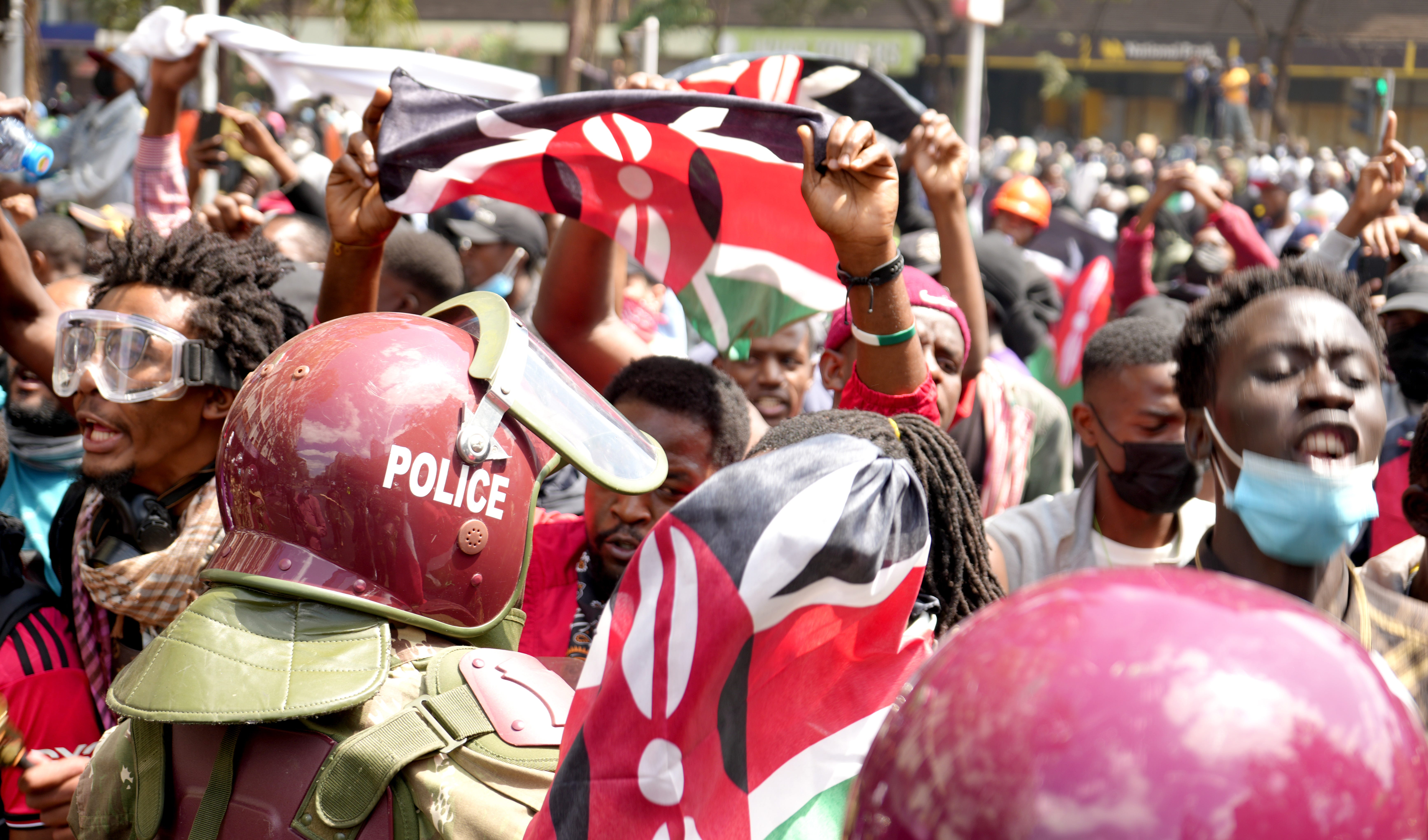
In June 2024, protests erupted in Kenya that nearly toppled the government. At least, it surely felt like we might overthrow President William Ruto, who had long been a favorite partner of major Western powers and international investors on the African continent.
For many people, the protests appeared sudden and spontaneous. But what is often left untold is the long story of grassroots activism, political education, and community organizing that created the conditions for such a moment. The Kenyan Organic Intellectuals Network, founded in 2019, emerges from this broader context of struggle.
All Kenyans, not just scholars and journalists, have thought hard about what 2024 has meant for the country. To mark the second anniversary of the uprising, the Network has compiled a book of its reflections on the meaning of the protests and the potential for real transformation in the country.
I was born in 1999 and grew up in Mathare, an informal settlement on the outskirts of Nairobi. During the Mau Mau struggle against British rule, Mathare was an important base for anti-colonial resistance.1 Since I was 17, I have been active in community organizing through the Mathare Social Justice Centre.
We were active in the protests in 2024 before everyone started watching. In April, residents here were severely affected by flooding. More than 70 people lost their lives, and then ten more died during government demolitions that left thousands homeless. In response, we organized protests demanding housing and justice for the victims. Young activists mobilized alongside many Nyakinywa—in Kikuyu culture, these are women whose sons have already been initiated into adulthood. Their participation gave the movement moral authority and demonstrated its broad support.
Then in May, the government began discussing a new Finance Bill, which would raise taxes on ordinary people. We decided to continue to mobilize — not just in response to the bill, but with our demand for housing as well. At this point, absolutely no one was calling us “Gen Z.” With older women around me, I did not feel as if I was in a “Gen Z” protest. It was not yet a global trend to describe the protests in that way. Kenya 2024 came before Bangladesh, before Serbia or the revolts in 2025 in Nepal and Indonesia and Madagascar.
As the protests increased in size in June, and the police opted for repression — I was arrested on June 18th along with 300 others — the media made a move that I think was intended to delegitimate and isolate us. First, they pointed to youth participation, suggesting that the participants did not take politics seriously. Then, the next day, the phrase “Gen Z” was everywhere in the press: you would read “Gen Z protesters” over and over. The world knows the next part of the story a little bit better: over the following days, protesters entered the Parliament building, and police killed a total of 67 people.
Before long, we were demanding that “Ruto must go.” In retrospect, I think that if the government had actually fallen in that way, it would have been the military that took over. There was no other political force that could be the recipient of the power unleashed on the streets. Instead, the protests created new movements and a new political reality that will be an important part of whatever comes next.
June 25th remains an important date in our political calendar, and we returned to the streets this year, last Thursday, to honor the victims and demand accountability for the dead. We were met with repression once more, and at the time of writing, two of our comrades are missing.
In my view, the focus on “Gen Z” serves to depoliticize the movement and to isolate it from broader struggles. At the same time, it is true that a new political actor emerged in 2024, and this relates to our specific historical and economic realities; we must understand the powers that we have in order to use them effectively to build a new Kenya.

Notes from an Unfinished Uprising — Kinuthia Ndung’u
I write this from my house, scrolling through media filled with horror from Tanzania. Hundreds of young people have been murdered after a disputed election. I imagine Nyerere turning in his grave, watching the humiliation of the people under the leadership of his party. It is the familiar story of the betrayal of the independence struggle by the new political elite across Africa.
In Kenya, the streets appear silent, but do not let that silence deceive you. Beneath it lies the same anger, the same pain, and the same unresolved contradictions that drove us into the streets in 2024. Lecturers remain on strike, the healthcare system is on its knees, corruption has deepened, and small businesses are collapsing under the weight of austerity.
Under Ruto’s leadership, Kenya has been further entrenched in the orbit of imperialism. The regime secured non-NATO Ally status, aligning itself openly with U.S. military interests, then joined the war against the heroic Houthis, who are defending the dignity of the Palestinian people. Our brothers and sisters have been deployed to die in Haiti defending US imperialism.
Domestically, Parliament has been sidelined through the Privatization Act. New land laws have deepened dispossession, and a Cybercrimes Bill has been weaponized to criminalize dissent. The state’s prisons still hold many of our comrades, maliciously charged with terrorism for demanding a better Kenya. It is a bitter irony, the British colonial state once called the Mau Mau terrorists too!
A year before the storming of Parliament in June 2024, I spent three days at the notorious Central Police Station for participating in anti-Finance Bill 2023 protests. Those who came to agitate for our release were violently dispersed from the station. The state was rehearsing. At that time, our generation’s political consciousness was not what it is today. We were dismissed as paid activists. Still, we persisted through coordination within the broader social justice movement.
By 18 June 2024, the streets erupted. “Ruto Must Go,” “Reject the Finance Bill,” and “Reject the IMF” echoed across towns. I stood along Tom Mboya Street with goosebumps, stunned by the sheer number of young demonstrators. On the second day, millions poured into the streets. Doctors set up makeshift clinics, churches and mosques opened their doors to shield protesters, and advocates camped outside police stations to secure releases.
Then, around 7 p.m., Rex Masai fell, murdered by a police bullet. The 29-year-old became the first martyr of the uprising. His blood stained Tom Mboya Street, and with it our fear died. Our anger and resolve hardened.
On 25 June, the culmination arrived. Across the country, thousands came out to protest. At around 5 p.m., Parliament passed the bill. When the news reached us in the streets, we charged toward Parliament, chants drowning out bullets and tear gas.
Kenyatta Avenue was renamed Rex Masai Avenue. The Governor’s office was set ablaze. The Supreme Court was not spared. The police water cannons ran dry. Tear gas and bullets ran low. Many patriots were killed across the country, while others were rushed to hospitals with serious gunshot wounds. In the city center, we carried our dead as we surged forward toward Parliament.
That evening, the military moved in. Helicopters hovered overhead. Soldiers patrolled the streets. The same state that claimed to serve us turned its guns on us. Inside Parliament, someone asked me, “Bro, what’s next?” My fear crystallized. That question exposed the central weakness of our uprising. We had spontaneously mobilized to confront unjust power, but we were not organized to sustain the protests, seize power and rebuild.
As momentum declined, the Raila Odinga-led opposition joined hands with the regime, claiming to save the nation from anarchy. In truth, the political class feared power emerging outside their control. Abductions, torture, and murders swiftly followed as fear spread. Several protest leaders crossed over to work with the regime.
At the center of our movement was the question of strategy: was Kenya still a neocolonial formation requiring a broad anti-imperialist alliance, or had the uprising transcended that stage? For some, assemblies were intended not as discussion forums but as embryonic structures of popular power capable of coordinating revolutionary action. Others, out of opportunism or wary after decades of political betrayal, emphasized spontaneity over disciplined central coordination.
In the vacuum that followed, the National People’s Council emerged. It bore the imprint of NGO logic. It lacked a revolutionary reading of the state. Its structures and analysis were alien to grassroots militants. It did not survive past its first national youth convention.
Since the retreat from the streets, a new narrative has been carefully constructed by the state, the media, and sections of civil society. The uprising is no longer spoken of as a class revolt against austerity and neo-colonial plunder, but as a “Gen Z problem.” The youth are recast as reckless, sentimental, entitled, politically immature children and sometimes drug addicts who want to destroy the nation. State violence is then justified as the restoration of order against supposed anarchy.
By isolating the uprising as generational rather than a demographic expression of class contradictions felt across society, the state seeks to sever it from the broader struggles of the majority of oppressed poor people.
Our task is to reject this fragmentation. We must neither be isolated from the broader struggles of our people, nor should we imagine ourselves as a substitute for the masses. The task of liberating our mother land is a collective one, and the future and success of our struggle depends on organization, discipline, and solidarity with all oppressed people around the world.
The fight is not over. The silence is not peace. It is the calm before the storm.

Kenya is not in crisis, Kenya is the crisis — Nicholas Mwangi
Kenya occupies a central place in the story of East Africa. This is a region celebrated as one of the cradles of humanity, and it is now the fastest-growing economic bloc on the continent. Since Kenya is positioned as the “bastion of pro-Western stability” and a “gateway” to the region, the country is routinely cited as a success story.2
Yet this growth has come alongside deepening inequality, rising debt, declining public services, and a crisis of legitimacy for the ruling class. This contradiction between GDP growth and mass suffering is not accidental. Austerity, debt servicing, and the privatization of life’s necessities are not policy mistakes.
This crisis did not begin with the 2024 Finance Bill. Nor is it merely about taxation. Kenya’s mass protests serve as a popular unmasking of the model of liberal democracy and market-led development in East Africa that have been hailed for decades but ultimately failed.
This is not just a Kenyan story. It is part of a continental crisis, a reckoning with the failures of post-colonial capitalism across Africa — from the anti-French rebellions in the Sahel to the strikes in South Africa, and the food protests in North Africa.
The formal colonization of Kenya began after the 1884–85 Berlin Conference. But foreign domination in Kenya was never uncontested. Resistance took many forms — from armed struggle to passive defiance — and unfolded in waves, reflecting both the resilience of Kenyan communities and the intensification of colonial repression.
By the early twentieth century, broader political and ideological currents began to influence the resistance movements in Kenya. The 1917 Russian Revolution and the formation of the Third International resonated deeply across the colonized world.3 The radicalization of the working class and peasantry in Kenya during the 1940s and 1950s set the stage for the Mau Mau uprising. Known formally as the Kenya Land and Freedom Army (KLFA), the Mau Mau under the leadership of Field Marshal Dedan Kimathi emerged as a powerful articulation of the structural violence that defined colonial capitalism.4
Despite its military defeat, the Mau Mau uprising shattered the myth of colonial invincibility, exposed the brutality of the British Empire to the world, and radicalized a generation of activists and political organizers. It also forced the British to accelerate constitutional reforms, leading to the eventual independence of Kenya in 1963.
If colonialism was outright theft, then neo-colonialism is professional theft. Kenya, like many newly independent African states, emerged from colonial rule with the promise of political and economic sovereignty. But the government soon introduced Sessional Paper No. 10, “African Socialism and its Application to Planning in Kenya” — a masterstroke of ideological misdirection. In fact, it was a capitalist blueprint, drafted with the full backing of the United States and the United Kingdom.
The post-colonial state, led by Jomo Kenyatta, inherited not only the administrative apparatus of the British colonial state but also its class logic. A new elite — composed of Kenyatta’s close political allies and beneficiaries of land patronage — entrenched themselves as custodians of imperial interests. Oginga Odinga, in his seminal work Not Yet Uhuru, warned:
The stage following on independence is the most dangerous. This is the point after which many national revolutions in Africa have suffered a setback...Internal elements of exploitation are closely related to reactionary external pressures.5
At the center of this betrayal stood the unresolved land question. When Kenya’s elite seized the opportunity to accumulate land for themselves, they reproduced old patterns of dispossession with Black hands. Figures such as Pio Gama Pinto, Bildad Kaggia, and Oginga Odinga who pushed for socialist transformation were sidelined, repressed, or eliminated.
In 2022, William Ruto was elected president on a populist platform dubbed the “Bottom-Up Economic Transformation Agenda.” He promised to prioritize the informal sector, empower small traders, and reverse the elitist trickle-down economics of previous regimes. Yet these promises quickly unraveled. The 2024 Finance Bill proposed new taxes on essential commodities and services, including a proposed 16% VAT on financial transactions and basic goods.
In the shadow of this bill were stark inequalities highlighted in a 2022 Oxfam report: just 0.1% of Kenyans own more wealth than the remaining 99.9%. Nearly 3 million people fall into poverty each year due to illness. On top of that, “Kenya is losing $1.1bn a year to tax exemptions and incentives — almost twice what the government spends on its entire health budget.”6
The 2024 protests challenged not just a piece of legislation, but an entire economic model. The rejection of mainstream parties was a reaction to their role as vehicles of elite self-enrichment rather than mass emancipation. The movement’s “leaderless” form also reflected a deep mistrust of traditional leadership structures, including both political and religious elites, who have consistently failed to deliver material change and are increasingly seen as complicit in elite capture.
We have traced the long organizing and factors that gave rise to the uprising, however, spontaneity is not strategy, and if this uprising is to evolve from revolt to revolution, it must be grounded in long-term political organization. As the euphoria of the protests fades, the risk of demobilization and co-option remains. There must be deliberate building of grassroots structures — people’s assemblies, co-operatives, and social justice centers and networks that not only contest state power but also begin to construct alternatives from below.
As Frantz Fanon reminded us, “Each generation must discover its mission, fulfill it or betray it.”7 This generation of Kenyan youth, born in the shadow of structural adjustment, austerity, and unfulfilled promises, is now stepping into its mission.

Mass Mobilization in the Age of Hyperimperialism — Mamka Anyona
Everywhere we see signs of a return to large scale conflict. The multilateral instruments and “soft diplomacy” that, since World War II, served as the veil for a “rules-based order” are being dismantled. The United States has launched attacks on USAID, the UN, Venezuela, Iran, and Cuba, while Europe is moving to the right and diverting social funding towards militarization.
On the continent, imperialist-funded conflict is escalating. The Sudan crisis is causing severe devastation in the Horn of Africa. Increasing instability in the Democratic Republic of the Congo threatens to spill over into a regional war. The Sahel, recently wrested from the control of imperial powers, continues to grapple with Islamist insurgents, while South Africa is experiencing a resurgent separatist movement.
This hypermilitarized world — a symptom of “hyperimperialism” — forms the backdrop against which Kenya’s young have been organizing and mobilizing against a government that is strangling their future in its cradle.
Most analysis of the uprising in June 2024, since labeled the “Gen Z protests,” has focused on the internal conditions. It is necessary for us to also understand these protests in the context of the dying kicks of a global order and unpack the dialectic between the objective conditions that situate the epicenter of growing global unrest in Africa, and the sophisticated instruments of repression that are themselves a product of the age.
Hyperimperialism is the result of a shift in hegemony. In this instance, hyperimperialism is being experienced as a stage in the decline of US global dominance.
Hyperimperialism follows the depletion of productive forces at the imperial core, and this has a blowback effect on countries at the periphery. While China and the Asian Tigers have positioned themselves in past decades to inherit industrial production, and the sub-imperial powers of the Gulf are making bank from the petrodollar, countries in Africa have struggled to build secure economic bases. Constrained by policies that aim to keep Africa as a source of raw materials, the continent has been unable to build a productive base.
Africa produces what it does not consume and consumes what it does not produce. Without industrial capacity, Africa is structurally incapable of absorbing her growing population of the unemployed, a category predominated by the young, into a labor force. As the population expands — and this remains the only continent where the fertility rate remains above replacement level — significant masses of young people will come of age in a world that has no place for them.
The unemployed on the continent are a different, far more hopeless category, than the “reserve army of labor” described by Karl Marx. They have been described by José Nun as “absolute surplus population,” but even more accurately, by Mike Davis in Planet of Slums, as “surplus humanity.”
The African continent is, arguably, the home of surplus humanity.
Capitalism would prefer that these young people not exist at all. And Africa’s young know it. They can feel that they are disposable. They see it every day in the manner that their government treats them. They see it in the stark divide between what they are given and what is taken away from them.
The Finance Bill 2024 itself was a product of hyperimperialism. In response to the protests, young Kenyans were met with the other side of hyperimperialism — a disproportionately violent, bloody and intense campaign of repression.
We must recognize that our ability to organize domestically has been significantly diminished. Beyond the heavy state infiltration and NGO-ification of Kenya’s resistance, labor organizing is also severely constrained. As in many nations, union concentration has diminished significantly. Trade unions, which once formed the backbone of organized resistance and which were a significant force during the independence struggle, have since been broken. Organizing resistance in Kenya must be understood as a fraught concept in the age of hyperimperialism. The nation-state which constituted the power which could change the lot of the lives of Kenyans has been supplanted by multinational corporations and finance capital. The anonymity that the analog era afforded our forefathers who resisted in underground formations is impossible in the age of hypersurveillance and state partnerships with companies such as Palantir.
A renewed commitment to an active Internationalism carries the potential to form the cornerstone of the next phase of resistance. Resistance today must span nations to be effective; it must capture entire regional formations where capital’s interests converge and seek to disrupt them there.
Africa’s surplus humanity must become the motive force for transcending late-stage capitalism. As the “developed” world fights for the crumbs left over by its exploitation of the planet, we use their age of confusion to leapfrog ourselves and humanity into a new era. Africa must be the vanguard for a new global reality.
A luta continua.
That struggle established traditions of collective action, solidarity, and resistance that shape community organizing here today. As Gathanga Ndugu describes in his book, Mathare was an Urban Bastion of Anti-Oppression Struggle. The 2024 protests were not only a response to an immediate crisis but also part of a longer history of resistance and self-organization in Mathare.
“East Africa - The Rising Economic Jewel of Sub-Saharan Africa,” Euromonitor, 28 September 2023.
“Africa Was at the Centre of Lenin’s Work,” Review of African Political Economy, 27 January 2022.
Maina Wa Kinyatti, History of Resistance in Kenya.
Oginga Odinga, Not Yet Uhuru (London: Heinemann, 1967), 256.
Oxfam International, Kenya: Extreme Inequality in Numbers.
Frantz Fanon, The Wretched of the Earth, trans. Richard Philcox (New York: Grove Press, 2004), 145.

