

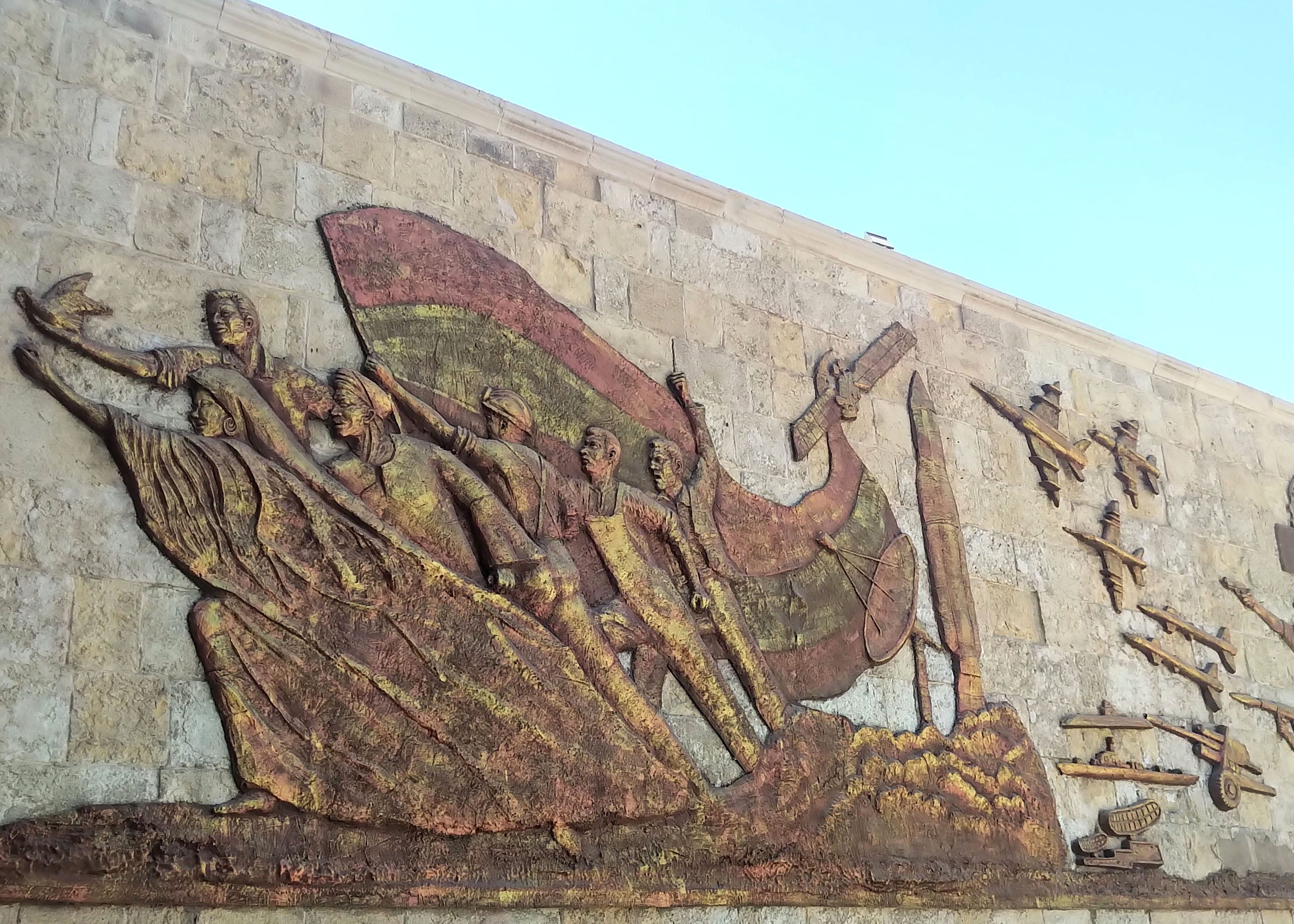
Over the last few years, young Egyptians have become interested in our history of anti-imperialist resistance. Many people have learned about Arab anti-colonial struggles for the first time, and now reflect wistfully on the era in which Gamal Abdel Nasser stood up to the West. This is a new nostalgia, a different political orientation than the one that powered the Tahrir Square generation.
Considering what has happened just across our border, the turn makes sense. Like the rest of the world, we watched a genocide live-streamed to our screens. But we have felt the tremors much more directly, as bombs drop and survivors huddle up in Rafah, just a short drive from Cairo. Palestinian flags hang everywhere on the streets of Egypt, and struggling families find money to donate to Gaza. We cry out at the images of dead children, unable to take any more.
All of this is submerged in a general sense of deep frustration. Almost everyone around me feels that General Abdel Fattah el-Sisi, who took power in 2013, has failed to stand up to Israel and defend Palestinian life. We know our country could have done more than offer verbal condemnation and ceasefire mediation – and that this used to be the kind of nation that would have.
In another era, instead of cracking down on Gaza protests – I marched back to Tahrir with the first major protest, and over a hundred of us were detained – our state would have taken on the Zionists. Far more than Westerners might realize, anti-Zionism runs deep in Egypt. Even before October 8th, 2023, one poll showed that 85% of Egyptians opposed the diplomatic recognition of Israel. After Mubarak fell in 2011, protesters attacked the Israeli embassy in Cairo. It is easy to suspect that fear of Egyptian anti-Zionism was one of the reasons Sisi’s 2013 coup found international approval in the first place; true democracy of the type demanded in 2011 would have ultimately created a political class opposed to Israeli and U.S. power in the Arab world. Despite the rhetoric back in Washington, it is obvious this is not what Barack Obama and Hillary Clinton wanted in the most populous country in the Arab world.
On the question of Israel, the country has become even more united since 2023. Now, 95% of Egyptians oppose normalization with Israel, and 73% have negative views of the United States. With the exception of a small minority of liberal West-worshippers and businessmen, Egyptians see Israel as the enemy. For my friends, and for the many supporters of the Palestinian resistance, the killing of Yahya Sinwar, chairman of the Hamas Political Bureau, contributed to a deep sense of defeat that felt equivalent to a second Naksa – the Arab loss to Israel in 1967. The images of Sinwar raising his hands to make the victory symbol, or flinging a stick at an Israeli drone in his final moments, became symbols of defiance.
I spent the last few years working as a journalist for a prominent national outlet and reflecting upon our place in the world. I covered the genocide in Gaza, the attack on Iran, labor relations in Egypt, and asset sales to the Gulf, trying to understand how my country really works. And the more I understood, the more my frustration at Sisi’s conduct deepened into anger that being Egyptian increasingly means living at the mercy of Israel, the U.S., and Gulf Arab states.
The closer we look, the more we encounter a double motive for frustration. Economic and geopolitical circumstances have changed radically since the 1960s. Even if we could magically change Sisi’s mind, Egypt would still find itself entrenched in a web of dependent economic relations. A change in posture would be quickly and severely punished. A simple return to Nasserist foreign policy would be insufficient, if it were even possible. We have to look further than the obvious imperialism of Donald Trump and Benjamin Netanyahu, the spectacle of bombs and blood; we have to understand contemporary economic imperialism to put together an anti-imperialist politics fit for the 21st century.
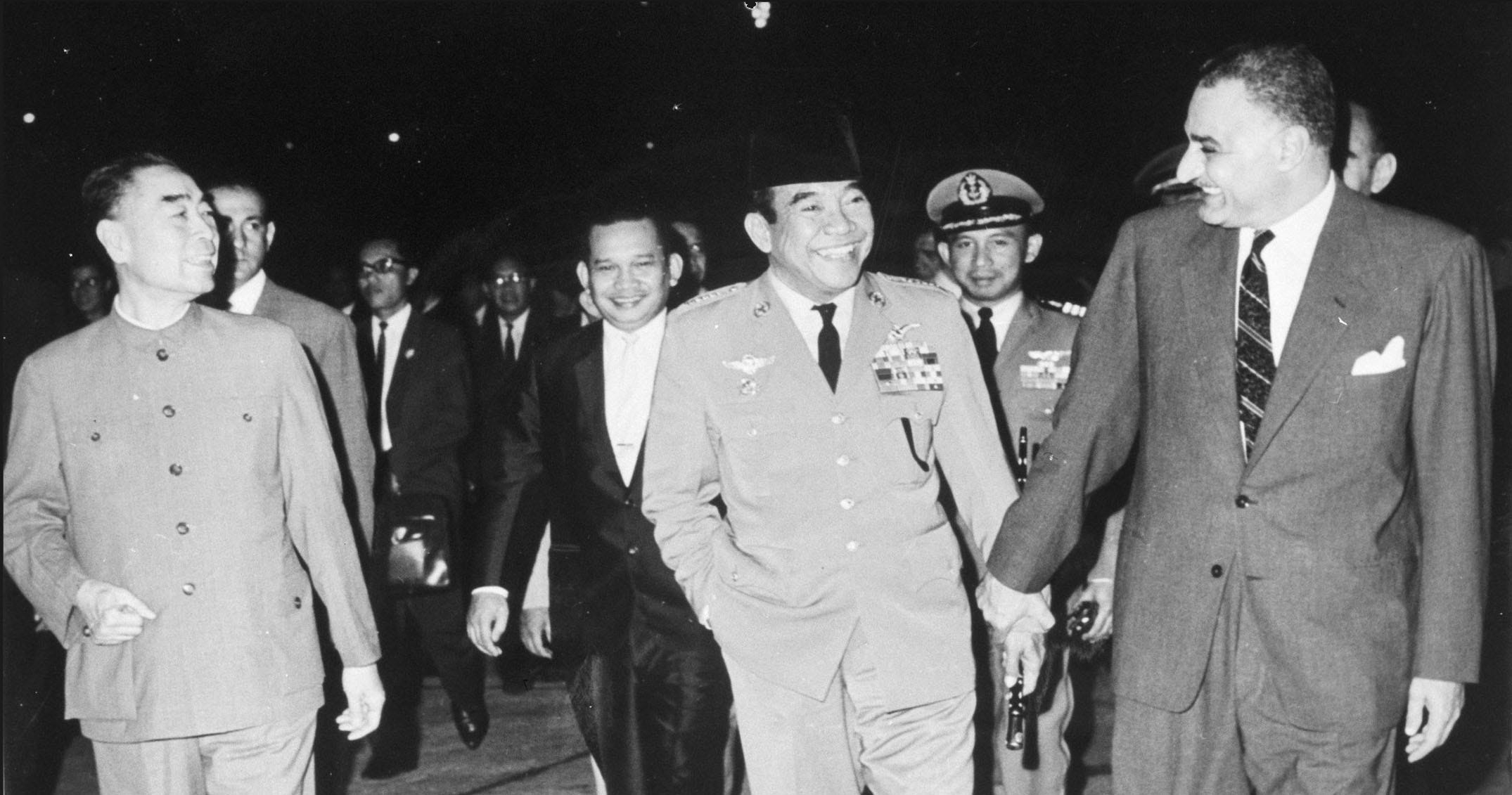
Nasser took power in 1952, in a milieu shaped by opposition to monarchy, feudalism, and British influence. Five years later, he shocked Western Europe and inspired the Arab world by wresting back control of the Suez Canal after a French-Israeli-British invasion. Soon, most of the region looked to Nasser and his version of “Arab socialism” as a source of inspiration; Washington genuinely feared a united Arab region embracing left-wing politics, and the Soviet Union offered (limited and select) support to Third World governments.
Then Nasser lost a war to Israel. As a result of the Naksa, Israel seized the Gaza strip and the Sinai Peninsula from Egypt, the Golan Heights from Syria, and the West Bank and East Jerusalem from Jordan. The 1967 war took a heavy toll on the Egyptian economy. Foreign currency was in short supply, wheat was scarce, and Egypt turned to seek the support of oil-rich Arab states.
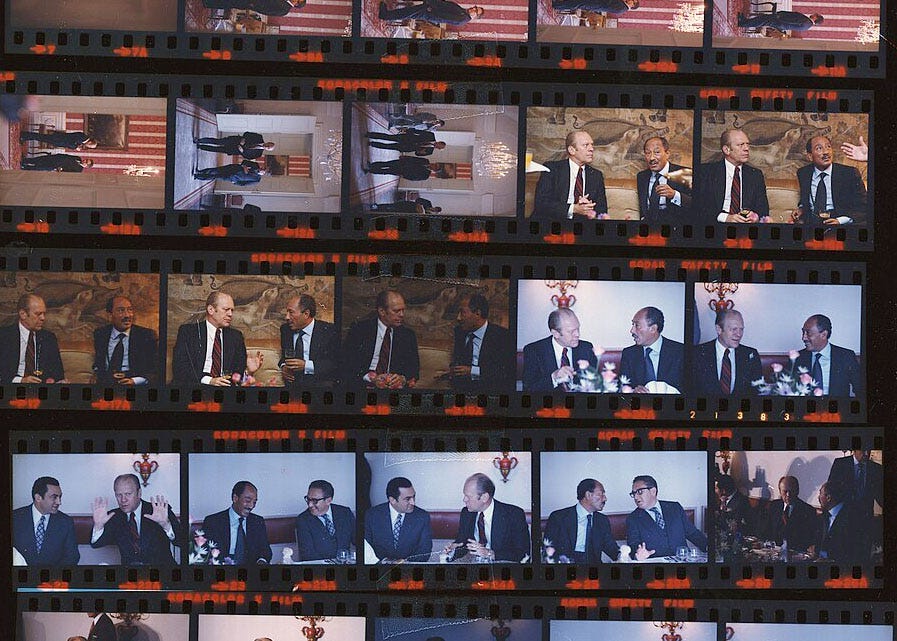
Anwar Sadat, who took power after Nasser’s death in 1970, would have faced international constraints even if he were committed to anti-imperialism and Arab Socialism. Instead, he was ready to embrace the West. The war Egypt launched in 1973 to take back Sinai concluded with the first Arab normalization with Israel, a security agreement with the US, and the opening of the economy to foreign investment.
In 1977, the IMF offered Egypt a large loan, on the condition that Cairo cut subsidies for basic food items. The popular response—known as the “bread riot” – marked the beginning of a delicate balancing act that is familiar across the once-proud Third World: International creditors and their partner regimes must enforce neoliberal policies and integrate Egypt into global markets, causing inevitable instability, while maintaining just enough peace to keep the state intact. The ruling class kept this balance, just barely, through the 80s, 90s, and the turn of the millennium. Egypt teetered on the brink of bankruptcy due to external shocks or global crises, and each bailout came with further political and economic entanglement. This meant a hellish cycle of more austerity, more privatization, more debt, ad infinitum.
These entanglements included a new relationship with a rising Gulf, forged in the 1980s as Washington and Riyadh sought to suppress the young Islamic Republic of Iran. Egypt’s participation in the 1990 Gulf War was repaid with debt forgiveness from the US, Europe and the Gulf. By the late 2000s, a series of privatizations and deregulations made life very expensive for Egyptians, while a new, corrupt business class arose around Mubarak and his son Gamal. All of this contributed to the rage that powered the Tahrir Square uprising and led to their downfall.
After the 2011 revolution, neoliberalization was briefly paused as Egypt and its allies prioritized restoring social order. But this meant burning through foreign reserves to maintain imports and subsidies.
In 2013, Sisi’s new regime was bailed out by the Gulf, which temporarily propped up dollar reserves. Soon enough, the shortage returned. By late 2015, reserves were hemorrhaging toward a historic low of $15.5 billion, coinciding with massive spending on megaprojects funded in part by construction barons who partnered with the government. Sisi was bent on proving his regime could be a better steward of the economy than the Brotherhood had been, and pushing an image of prosperity, in order to cement his legitimacy and mollify investors.
The era of Gulf bailouts was over. Egypt was long overdue for a return to the neoliberal track. Sisi buckled, ushering in an era of devaluations, asset sales, subsidy cuts, and radical privatization plans that included even military-owned companies.
But the real shock came in 2022, when Russia invaded Ukraine. Egypt is the world’s largest wheat importer, with Russia and Ukraine providing over 80% of its supply. As prices soared, the government made a new deal with the IMF in 2022, which came with massive currency devaluation and more subsidy cuts. The Egyptian pound went into freefall, while food and fuel prices soared.
The period between 2022 and 2024 was one of chaos and panic. People, already repressed and stripped of collective bargaining power, could only watch in despair as their salaries and savings plummeted to a third of their former value. The state was in a state of panic, too, hunting for people who might be hoarding dollars or stores of scarce commodities like sugar. I remember the despair, and helplessness, as we saw stories emerge of family members killing each other over money.
A dollar crisis was compounded by an energy crisis, and together, they kept Egypt on a very tight leash. In 2024, some relief came when Egypt sold a chunk of its Mediterranean coast to the UAE. Worst of all, since 2018 Egypt has been increasingly dependent on Israeli natural gas exports. Israel shut down its gas fields multiple times during the genocide, pushing Egypt into moments of internal chaos as the government enforced daily blackouts. One remembers when the national shame, under Mubarak, was that we were exporting gas to Israel.
In moments of rage and pride, my friends and I entertained the fantasy that Egypt would declare war on Israel. But more realistically, a few concrete actions were possible. Egypt could have opened the Rafah crossing and forced the admission of aid trucks. We could have put more pressure on Israel and allies by suspending relations or allowing more popular protests for Gaza. In the current conjuncture, that surely would have meant dire consequences – the disappearance of dollar reserves, of food, and electricity. In short, chaos – even before we consider the kind of sanctions that could be placed upon us, as they have been with such devastating effect on Cuba and Iran. Would I be willing to withstand all of that? Yes, I think so. But Sisi and his constituency would never.
Instead, we got repression. There is still some space, online, to vent and to share dark humor about our situation. But you never know which post might get too much attention, and lead them to drag you in on charges of terrorism. This is the elephant in the room – and the reason I am writing under a pseudonym for this contribution. This is an insecure regime that will crush dissent and imprison its population at the whiff of a threat to its power. And this repression is in service of sustaining dependency, not resistance.
In the fabled years of 2011 to 2013, my generation’s attitude to Nasser was very different. There was a small Nasserist current in the revolution, but criticism of Nasser was the dominant trend. Islamists, leftists, liberals, and democrats all tended to remember the (real) political repression that marked his era, and the long military epoch it inaugurated. Leftists also criticized his “Arab socialism” as too capitalist and top-down. And everyone blamed him for losing the 1967 war. His face had been used in memes as a symbol of defeat and failure, as a signifier of a lot of bark and no bite. I was 18 when the revolt exploded, and I accepted most of this quite naturally.
And there is still much truth in all of this. But, like many Egyptians, I spent the last decade moving from a critical to a more respectful view of Nasser. I came to re-evaluate the Nasserist period without actually softening my critiques of his failures. What changed is the context.
As I learned more about imperialism, the world system, and the trials and tribulations of sovereign states in the Global South, I came to appreciate the parts of Nasserism that were thrown out with the bath water: defiance of the West, Israel, and regional reactionary forces; support for national liberation movements, and the drive to industrialize and provide basic welfare for Egyptian citizens.
The story of 1967 as a total failure had placed the blame squarely on Nasser and his inner circle. Smuggled into that critique, however, was the implication that we should never have stood up to Israel in the first place.
I still believe that Nasser’s government was repressive. But Sisi is far more repressive, and it’s painfully obvious that internal repression is not the reason that the West opposed Arab Socialism. What matters more is a given state’s relation to the global economy and imperial politics. We still have the military structures that the Nasser period gave us. But what is the point of having a military if it will not oppose a genocide taking place five hours away?
Still, none of that resolves the bigger question: How can we move from nostalgia to real anti-imperialism today? One of the many things we learned, back in the chaotic years of 2011 to 2013, is that simply removing a hated leader does not guarantee a happy ending. I can only offer here my own reflections on the beginning of that journey.
The majority of Egyptians would love to feel strong enough to stand up to Israel and the West, and to do more for Palestinians. But we have long been denied any say in our country’s policies. At the same time, we are keenly aware of the heavy price of facing down imperialism, which we have seen paid by the Lebanese, the Palestinians, Iranians, and, indeed, by Nasserist Egypt itself. At times, I feel that without the collapse of U.S. hegemony, or the magical reappearance of some kind of Soviet Union, we are stuck on our current path.
Egypt’s situation is not unique in the Global South. Yes, one can argue that Sisi should have made better economic decisions, as an individual. But a quick look at the regional and global reaction to the genocide reveals a web of relations that entangle most of us. Our current condition is one of dependency that condemns us to weakness and impoverishment. The only path of resistance I see in the short term, regardless of our leadership, is one paved with blood, starvation, and isolation. Luckily, we are able to reflect on our history, and learn, as we look far beyond the short term.
Images, in order: the Egyptian Military Museum; a photo of Nasser (far right) with Zhou Enlai and Sukarno; photos of Anwar Sadat meeting with Gerald Ford and Henry Kissinger.
Terrific piece, filled in a lot of detail I didn’t know about Egyptian political history. Devastating odds the Egyptian people are up against in challenging the current economic/imperialist order, like most of us. Thanks Vincent🙏